Neville's Haze, in search of a keeper

I encountered the most number of plants that showed some nodes with 3 branches on them
I had three NH girls this year. Two smaller ones had this trait (25L fabs), but I only noticed on the initial manicure.
One had a Kush like appearance (bushy - ghille suit🙈), long central cola, medium branches, fine sativa leaves and three branches for every node from the bottom branches through into the top cola. Thinner inflorences like my taller SSH.
The 2nd I discovered had five branches per node, three dominant like above plus two smaller less developed ones not in symmetry but within a mm or two of these three. Also more than a quarter of the branch tips split into two buds at the end, all buds golf ball size. No Christmas tree shape even though untipped. Sativa leaves mostly hybrid initially.
Third was great (90L fab), fatter, taller, denser plant and inflorescences than the SSH and 5H in my thread, maybe NL pheno?
Still under cure and requiring final trim. No smoke report yet but all unique and droolisious.
Impressive strain, so far. All were picked slightly earlier than expected due to mild mould outbreaks after excessive rain days, but still nice. In contrast a few Asian girls never flinched and grew on through to June, ~18 weeks of flower.
 
Last edited:
Hello Switfy,

I'm going to follow this thread closely as I'll probably be launching NvH in the near future.

Good luck.

About your problems with the Jiffy "soil" cubes, it's sad but these cubes from what I know work quite badly even without mould.
I tried these things a long time ago. Half the cuttings had rotted away... The air doesn't circulate enough in these cubes and they retain too much water, not to mention their tendency to rot since they're organic matter.

Use rockwool cubes, for cuttings that's best. Or if you don't like rockwool, perlite works pretty well too.

Now that the damage is done, if you have calcium hydroxide (Ca(OH)2) you can try adding a little, diluted in water whit ajusted pH, to limit the problems, as it kills almost any fungus instantly.
Hello Zero0,

thank you for your info and experiences! appreciated.:)
I have been cloning for 20+ years with peat cubes now and for me they work best so far.
Nice to read about other peoples successes and this shows again that there are mant different ways to be succesfull.

Greetings.
 
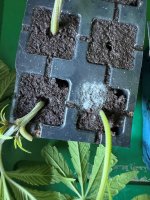
Hi Swifty, peat moss naturally contains beneficial bacteria, one of which is called "Streptomyces'. Most people assume that peat is sterile, but it's not unless a manufacturer intentionally makes it sterile. Here in Canada, I always use the Pro-Mix brand of peat moss, which isn't sterile. That white fuzz looks, to me, like a Streptomyces mycelium bloom. If that's what it is, then it's beneficial.

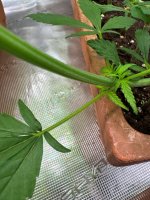
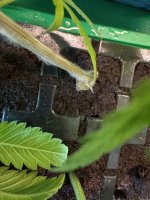
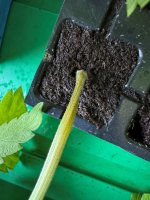
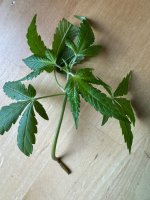
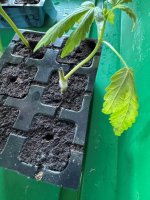
View attachment 101117View attachment 101118View attachment 101119View attachment 101120

Thank you Freedom_Fighter.(y)
You eased my mind a little bit more, you have a wealth of knowledge.😊
It is very possible that this is what was showing in the cubes.
 
Today is day 6 of flowering.
Small update, nothing much to see.
I will continue to prune leaves and branches until each plant has 1 decent branch left to flower out.
Still prudent in the pruning (bigger fan leaves), I want to make sure that I have a clone from each plant.
Led is at 50% and they have light feedings of Alga Grow, I will switch as soon as they show sex.

NH58.JPGNH59.JPGNH60.JPGNH61.JPGNH62.JPG

@Wobby,

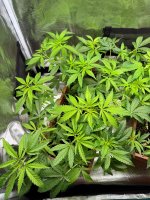
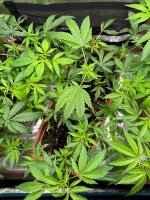
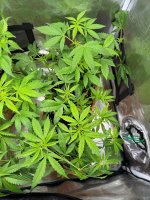
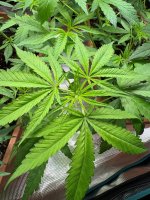
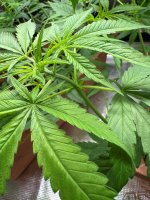
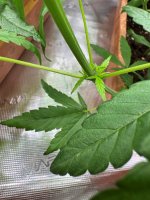
This is one plants that has 3 branches/leaves on every node.
It is the only one with this trait, the rest show a branch or a node but not as consistent as this one.
I do like the look of it, hope she is a girl!
Here some pics of the top and every node:

NH63.JPGNH64.JPGNH65.JPGNH66.JPGNH67.JPG

Clones look ok today, no signs of the fuzz.


mu
 
To come back to the problems caused by mould, using beneficial microbes (trichoderma, etc.) and enzymes I think is sufficient to prevent in "living soil" cultivation.


mu

Hey Musashi, thanks for those valuable resource links. They are definitely of high value to me and definitely on-point with the topic of living soil IPM.

Great to see you were on top of "streptomyces" way back then. I didn't discover it until 2020. I've looked at that product before. It's very attractive to me but I've never tried it.

Streptomyces, at least certain ones, not all of them, is synergistic with fungi & yeast and certain microbes (e.g. TeraGanix EM-1). When the three are combined, their alchemy creates a powerful effect. Very difficult for any pathogen to break through it. But no need to stop there, unless one has reached the point of diminishing ROI.

For me, I would probably shoulder the extra expense for a short time, if it was to provide extra protection to highly valued mother plants, that could be alive for a couple years, depending on one's circumstances. I would definitely spend the extra for a good myco product for plants I may keep living for a year or longer. But I'm not rich, so if prices double or triple in the future, I may drop out of that market, eventually.

Much respect. Cheers, bro'. FF
 
To come back to the problems caused by mould, using beneficial microbes (trichoderma, etc.) and enzymes I think is sufficient to prevent in "living soil" cultivation.

Streptomyces prevents harmful mould(s) from developing, especially when combined with the right things. As for an enzyme product, SLF-100 is worth checking out, for those interested in an enzyme product for grow medium ipm. Here's a couple good videos on it:

SLF 100

SLF-100 Organic Enzymatic Formula

... and 'The Amazing Doctor Zymes' is another good one, worth checking out, for those in the USA & Canada (Little Cuba).

Chemical Defenses in Cannabis : Wikipedia
 
Last edited:


mu
Thank you mu!
I will study Streptomyces, I try to keep it as simple as possible in my grows but this could be a very beneficial addition.
 
After 20+ years of cloning this is a first for me.:confused:
I lost 22 clones already and I suspect that 7 will follow.
Not nice to see but that is also part of growing.
I checked my mom's and I will be able to take extra cuts of each plant by next weekend.
Thinking of redoing everything then.

I have other cubes from the same brand (but bigger) bought earlier and I tested that batch already past winter.
I will go to these now and dissinefect everything.
Needless to say that I tossed these cubes.

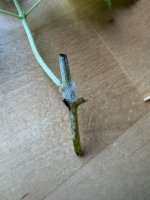
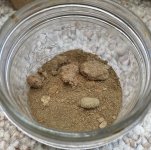
For educational purpose some pics of the problem, it aint pretty.:rolleyes:

NH68.JPGNH69.JPGNH70.JPGNH71.JPGNH72.JPGNH73.JPG

I would like to thank everyone for pitching in and giving their opinion and advice.(y)
 
Hi Swifty,

It's sad but it was to be expected.


Wash your cloning equipment with real classic soap (Marseille soap, black soap, etc.). The sodium hydroxide it contains is enough to disinfect fungus attacks.
Bleach is good also but more dangerous to use.


As I said in my previous post, you still can try using calcium hydroxide to treat the remaining healthy cuts.

Calcium hydroxide can be used in the soil and can be sprayed into plants, it is in reasonable quantities very well tolerated by plants.

However, this material is a strong base, so to make it water-soluble and suitable for use in the soil or spray, the pH must be adjusted before use.

Calcium hydroxide has the advantage of transforming over time with CO2 and humidity into calcium carbonate, which is completely harmless, even to fungi.
This material is therefore relatively easy to wash, after a spraying session - a generous amount of water is all you need.

Be careful not to use calcium hydroxide directly with micro-organisms that are beneficial to the soil, as this material kill them just as well as problematic fungi.


For your new cuttings, use rockwool cubes - I think that's a classic - or perlite, but in that case you need to compress it a little around the stem of the cuttings.

And if you still want to limit the risks of rotting, use cutting hormones in powder form instead of gel.


Good luck. (and sorry for my bad english)
 
Last edited:
I will study Streptomyces, I try to keep it as simple as possible in my grows but this could be a very beneficial addition.

Hey Swifty, sincere condolences bro'. It's a hard blow to take. I can just imagine the frustration and pain of loss, especially after a 20 year run without ever encountering this. That's a pretty good run, by any standard of measurement.

Streptomyces is a fascinating topic, well worth looking into. It falls under probiotic farming with beneficial bacteria; in balance and harmony with natural law. One of those natural laws is referred to as competitive exclusion; also well worth the effort to understand; and to know how to apply it, as part of an effective biological IPM approach. Fusarium gained a foothold due to an imbalance of the microbiology in your grow medium.

There are two ways to deal with such a problem, essentially : antibiotic and probiotic. Probiotic is preventative but also remedial, able to restore the balance required for a healthy ecosystem. EM-1, for example, is an example of a probiotic blend of effective microbes (i.e. beneficial bacteria) that can remedy the situation, at the correct rate of application. Its effects are dose dependent.

Trichoderma would have also prevented the problem, by way of the competetive exclusion principle.

Some helpful educational resource material:

1.) Probiotics for the SOIL?

2.) Beneficial Bacteria: Restoring Nature’s Balance, NobleBio || Cortical Studios

3.) CLOSTAT - Probiotics - Kemin || Cortical Studios

4.) CLOSTAT & Competitive Exclusion - Probiotics - Kemin || Cortical Studios

NOTE: The above is a short clip from the video in the third slot.

5.) What is competitive exclusion? | Southland Organics
https://www.southlandorganics.com/blogs/news/what-is-competitive-exclusion

The law of competitive exclusion is one of the MOST important lessons in organic gardening and probiotic regenerative farming. It is indeed a proven and well established "natural law".

FF 😎👍🏻
 
Fusarium. Looking at weak stem coming out of soil, compromising cell structure. Get rid of soil, gloves etc., off site not in compost. Decontaminate pots, tools with bleach.
Sorry @Swifty, for your difficulty. Sometimes hard to diagnose in early stages.

mu
Thank you mu, I'm able to redo it so nothing is lost.
I am making a plan to make sure everything is covered with sanitizing.
A clean fresh start is in the makings.

Hi Swifty,

It's sad but it was to be expected.


Wash your cloning equipment with real classic soap (Marseille soap, black soap, etc.). The sodium hydroxide it contains is enough to disinfect fungus attacks.
Bleach is good also but more dangerous to use.


As I said in my previous post, you still can try using calcium hydroxide to treat the remaining healthy cuts.

Calcium hydroxide can be used in the soil and can be sprayed into plants, it is in reasonable quantities very well tolerated by plants.

However, this material is a strong base, so to make it water-soluble and suitable for use in the soil or spray, the pH must be adjusted before use.

Calcium hydroxide has the advantage of transforming over time with CO2 and humidity into calcium carbonate, which is completely harmless, even to fungi.
This material is therefore relatively easy to wash, after a spraying session - a generous amount of water is all you need.

Be careful not to use calcium hydroxide directly with micro-organisms that are beneficial to the soil, as this material kill them just as well as problematic fungi.


For your new cuttings, use rockwool cubes - I think that's a classic - or perlite, but in that case you need to compress it a little around the stem of the cuttings.

And if you still want to limit the risks of rotting, use cutting hormones in powder form instead of gel.


Good luck. (and sorry for my bad english)
Thank you Zero0 for your post,very useful and I'm sure it will help others reading this.
I will source some calcium hydroxide, it is easy to get and it is good to have it as a back up.(y)
I did started cloning along time ago with rockwool and rooting powder, Pherhaps I should revisit it again to see If I can get the same results as now.
With the peat plugs and clonex I'm used to get 100% succes rate.

Hey Swifty, sincere condolences bro'. It's a hard blow to take. I can just imagine the frustration and pain of loss, especially after a 20 year run without ever encountering this. That's a pretty good run, by any standard of measurement.

Streptomyces is a fascinating topic, well worth looking into. It falls under probiotic farming with beneficial bacteria; in balance and harmony with natural law. One of those natural laws is referred to as competitive exclusion; also well worth the effort to understand; and to know how to apply it, as part of an effective biological IPM approach. Fusarium gained a foothold due to an imbalance of the microbiology in your grow medium.

There are two ways to deal with such a problem, essentially : antibiotic and probiotic. Probiotic is preventative but also remedial, able to restore the balance required for a healthy ecosystem. EM-1, for example, is an example of a probiotic blend of effective microbes (i.e. beneficial bacteria) that can remedy the situation, at the correct rate of application. Its effects are dose dependent.

Trichoderma would have also prevented the problem, by way of the competetive exclusion principle.

Some helpful educational resource material:

1.) Probiotics for the SOIL?

2.) Beneficial Bacteria: Restoring Nature’s Balance, NobleBio || Cortical Studios

3.) CLOSTAT - Probiotics - Kemin || Cortical Studios

4.) CLOSTAT & Competitive Exclusion - Probiotics - Kemin || Cortical Studios

NOTE: The above is a short clip from the video in the third slot.

5.) What is competitive exclusion? | Southland Organics
https://www.southlandorganics.com/blogs/news/what-is-competitive-exclusion

The law of competitive exclusion is one of the MOST important lessons in organic gardening and probiotic regenerative farming. It is indeed a proven and well established "natural law".

FF 😎👍🏻
Thank you FF, I will look into your info.
I try to keep it as simple as possible for now just because I don't have enough time to dive deeper in living soils and cultiviating beneficials into the medium but this route will be taken in the future!
 
Thank you FF, I will look into your info.... this route will be taken in the future!

I quite stumbled into the knowledge of it myself, through my discovery of a unique American hand crafted bokashi developed by Alan Adkisson. He started a movement of probiotic farmers online, who joined his PFA Facebook Community, which has close to 35000 members. Activity dropped off a bit during the last few years, but it's still a great hub of learning where you can get answers.

Probiotic Farmers Alliance / Probiotic Products Beta Testing Community
https://m.facebook.com/groups/526778890711264/

A few posts by Alan Adkisson. He's a bit of a nature mystic, influenced by Native American spirituality. Anyway, he has gone deep into the "rabbit hole" of Streptomyces exploration and evolution:

Streptomyces, Myceliation of the Triune Brain : Alan Albin Adkisson
https://www.facebook.com/share/p/1KMNq2n58W/

Things I Think About : Alan Albin Adkisson
https://www.facebook.com/share/r/1Dte9vuPQK/

HYPOTHESIS : Alan Albin Adkisson
https://www.facebook.com/share/r/1AhztAdW8j/
 
It only takes one time to realize the devastation that can occur. A plant can be systemic yet be asymptomatic for quite some time. I lost my prized trifoliate NL5/Hz, my MoX and my Holy Grail mothers to this stuff (using the same razor on the same cutting board). It's one thing to have backup seeds to start over and quite another to forfeit a plant you have found through hard work and generational selection. Fortunately I have a braddah who has a copy. Good practice involves cleaning cutting tools after each cut made on different clones. Use a sterile syringe to apply cloning compound to each clone instead of dipping (I squirt watered down gel into the hole made in the soil before inserting the plant). I scrub all pots before use, and then soak them in a bleach solution before putting soil and plants into them. I presoak my seeds in a kelp and h2o2/or bleach solution to kill viruses that may be on the seed. As with antibiotics, remediation can do damage to the microbiome resulting in slower rooting. I ameliorate this by using teas and other bacteria inducing supplements like fish emulsion and or kelp to repopulate/recharge the soil. And soil can be solarized before use. My 2 cents. I am glad that all is not lost @Swifty.
My BD today, breaking out the good stuff. hash.jpg

mu
 
Back
Top