How to get those tough and old seeds to germinate

Anybody have an idea why seeds from one strain can be really small and seeds from another strain can be very large?

I have seen seeds tiny as a pinhead and seeds almost as large as peas, what's the dynamics behind that?

Is it geographical or just a coincidence?

Cannabis is widespread across the world, all the way from southern tropical regions to arctic regions in the north. There must be some variation between how the seed works when comparing strains from say Africa and Russia, since the strains themselves show so much variation. Naturally there is variation across the strain too, so it might be individual.

Hi Kodiak ,

Thats a really interesting question .

I guess this has to do with the evolution of the strain , gene expression / breeding , but I cant answer in depth as I haven't really researched on this topic much.

I gather smaller seeds could be carried some distance by the wind, while larger and heavier seeds will ensure that the seed finds the ground.
To be honest I dont think cannabis seeds were designed to travel by the wind really , unlike other types of seeds from other plants , I think they just fall down with a bit of help from the wind (when the calyx opens n they are ripe) or make it to the ground when the plant dies .

Big seeds does not always mean big seedlings, although i figure that the energy stored in larger seeds will last the embryonic plant a bit longer than the energy stored in smaller seeds.

Any takes on this ?
I don't really think that big seeds can last longer , as even though there may be more food for the embryo , the embryo is bigger as well so needs more food. Though in practice I think that Indicas that usually have bigger seeds (compared to sativas) have seeds that last longer. Perhaps they are harder to dehydrate or they have a higher % of endosperm mass vs embryo mass .. just a guess..

BTW Here is a nice thread on big and small seeds over icmag:

http://www.icmag.com/ic/showthread.php?t=46988&page=2&pp=15&highlight=smallest

heres some nice info from Sam_Skunkman on seed size (taken from the above thread):

Sam_Skunkman said:
''I have seen seeds several times bigger in the same bud. If the first seeds are made and finished when the plant only has a few stigmas they will be large, if later the plant is pollinated heavily the seeds will be lots and small.
-SamS ''

''Yes larger seeds in general yield larger calyx's. The exception can be if a large seeded variety with large calyx's is pollinated by a small seeded variety male the seeds will be big, but the plants grown will have large seeds and the calyx's may or may not be large enough to cover the seed.
I have done the same with small seeded mothers pollinated with a large seeded father, they give small seeds that when grown the seeds are often to big for the calyx's.
I am saying in F1 populations it is the mother that controls the F1 seed size while the F2 seeds will express the size of both parents of the F1 seed, usually half way between the two.

-SamS''
 
Last edited:
Defender of Ruderalis

Thanks L33t, that post from Sam the Skunkman shed some interesting light on the question. I never made the calyx to seed size connection, that would mean that the size of the seed is to some part at least, determined on the individual plane through the genetics expression of the parents and to what degree the female gets pollinated.

So in short, the female plant strives for larger seeds but seed size is ultimately determined by the degree of pollination by males. She compromises size for quantity. Lightly pollinated females would by this line of thinking produce larger seeds where "quality" once again comes to play. The F1 offspring of this lightly pollinated females will also display larger calyxes and big seeds, unless that female is in turn heavily pollinated by a new male. The F2's on the other hand will express the middle road of both parents. So medium sized seeds is probably the norm.

I think you are right about Indicas having bigger seeds, that might be because Indicas stem from arid regions whereas sativas are tropical plants. Humidity might play a big part in the way the seed genetics presents itself. In arid regions humidity might be low and the seed needs to retain more moisture inside the seed itself from the start, than seeds from plants that make their home in tropical areas. That would also mean that generally Indica seeds will take a little longer to germinate but they can handle lower levels of humidity while sativa seeds germinate faster but are more at risk of drying out.

How this relates to the thickness of the seed coat is anybody's guess.

I know that cannabis seeds mostly fall to the ground and if they travel longer distances it's probably birds that do the dispersion. That raises another question, how well adapted the seeds are in response to gastric acids. I mean, are cannabis seeds dispersed by birds or not? One would think that they have to be since it is so widespread, or maybe it's us humans that have dispersed the seeds along the planet. Cannabis has after all been used traditionally as medicine and for shamanistic purposes for thousands of years. Maybe the dispersion and genetic variety of this plant is mainly due to human use.

That's an interesting thought :)

Cannabis sativa is older than cannabis indica and c. indica is considered a subspecies of c. sativa but they must have had a common ancestor at some point and then split up into two different genetic expressions of that plant, which must be a geographical expression. My guess is that tropical sativas came first as the temperature and humidity at the equator is perfect for these plants. Then it traveled north and gave birth to indicas.

At first I thought that c. ruderalis must be a closer relative to indica than sativa, but this is not the case. Cannabis ruderalis is considered a subspecies of cannabis sativa. The term Ruderalis was originally used in the former Soviet Union to describe the varieties of hemp that had escaped cultivation and adapted to the surrounding region.

http://cannabisculture.com/articles/3033.html

Indica is also classified as a subspecies of sativa that made it's way up north by natural (or perhaps supernatural) means and gradually acclimatized through natural selection. Ruderlis is the other subspecies of sativa that was planted by us humans, later escaped and had to adapt much faster to the short days at the northern latitudes, giving birth to the low-thc hemp that autoflowers regardless of photoperiod.

I may be wrong on this but it makes a lot of sense.

I know a lot of testing was done on cannabis ruderalis by the super sativa seed club back inte the day as they were trying to come up with potent plants with short flowering periods. Some of these strains exist today, like ruderalis indica, ruderalis sativa and four-way. Since c. ruderalis is a close relative of c. sativa, one could propose that working with haze and ruderalis could eventually produce some interesting fast flowering hybrids that retains the potency of the parent, or at least something close to it. After all, the auto-flowering trait must exist in some degree in c. sativa too as c. ruderalis is a direct decendant of c. sativa.

Too bad no one sells pure ruderalis seeds anymore. There are some crosses from sensi that could be used and of course lowryders but it would be fun to start from scratch :D

I do not understand why people put down lowryder strains and c. ruderalis in general. They might not be the plant of choice indoors or at lower latitudes but up north they are about the only thing can can finish in time during the small window of correct photoperiod that lasts only six weeks or so. Besides, I think that working with ruderalis outdoors could be a blast, especially when crossing it to the most potent sativas and indicas around. Lowryders are fun but they leave something to hope for in height. Stuporsonic is just about the only 100% auto-flowering sativa out there but that also proves that it can be done.

The fact that a tropical sativa was able to adapt to a colder climate and an alien photoperiod over a relatively short period of time, speaks for the versatile nature of this plant.

I think that all varieties and expressions of this plant are good and important.

Just a thought

-Kodiak-
 
Last edited:
Double Taproots

...odd... :confused:

I just germinated some Jock Horror seeds and two of them had dual taproots.

Is this good or bad for the plant? Will there be two plants sprouting from the same seed or what's the deal?

If it is one plant with two taproots I gather it will be a strong one, but I have not seen this before.

If they are in fact twins, I'll see how they develop. If everything goes fine I'll keep both, if not, I'll try to separate them or eventually cut down the weaker one. Since they are both from the same "egg", I gather that they are identical twins. If both survive, I'll just do my normal LST training on both which usually gives me positive results. If they turn out to be female and I separate them, I'll have a clone ready without all the hassle with the clonex and water and what not..

Pretty sweet. There are always new things to learn, the wonders never seize :)
 
Last edited:
Twins!

Well, seems like there were two plants inside one seed.

I think that they must be identical twins as they came from the same "egg".

Not sure though as twins and multiple births can be monozygotic (identical) or dizygotic (fraternal), meaning they arise from one or two fertilization events.

So there are a few possibilities:

1. Monozygotic Twins = Identical, same sex (male-male or female-female).
2. Dizygotic Twins = Not identical, same sex. (male-male or female-female).
3. Dizygotic Twins = Not identical, different sex (male-female).

All of the seeds cracked within 24 hours and the taproots grew very long in a very short time. I guess that the twins were competing for energy and space.

All plants in question were fully developed, with cotyledons, taproots and all, and they looked very healthy too. I managed to separate the plants and transplanted the duplicates to new pots.

Excellent! :cool:

I always order some Nirvana seeds with the rest when I place an order, their gear throws out some strange things now and then.

Now all I can do is hope that the plants turn out as identical twin females.

Either way, it will be interesting to work with these plants.

EDIT: One plant from each pair of twins were weaker and smaller so I saved the strong ones. Guess I will never find out if they were identical twins but I have three healthy Jock Horror plants to clone so in the end it's all the same.
 
Last edited:
Hi Kodiak ,
Nice piece of advice here , it work very well,
I recently put some 14 nev*mango seed after 24hr soaking and 12hr in a small box with wet tissu i had no sign of anyone opening just a few starting cracking shell.

They still seem very slow to react .

On the other seed that looked fully closed it tried to remove a small chunk like advised here , 3 hr later i see the germ coming out !
Not on all but on some that were fully closed after about 40hr of soaking :)
 
Sure, no worries, I'm glad it worked :)

Good luck with the Nev's x Mango, I bet those plants will be something spectacular.

Happy Growing
 
LOL i have gotten alot of the showing tail and then giving up in old dutch packs of alot of strains threw the years.

as for scuffing,,,,lay some sandpapaer in some thing likea match box and shake shake shake YOur booty:cool:
 
...odd... :confused:

I just germinated some Jock Horror seeds and two of them had dual taproots.

Is this good or bad for the plant? Will there be two plants sprouting from the same seed or what's the deal?

If it is one plant with two taproots I gather it will be a strong one, but I have not seen this before.

If they are in fact twins, I'll see how they develop. If everything goes fine I'll keep both, if not, I'll try to separate them or eventually cut down the weaker one. Since they are both from the same "egg", I gather that they are identical twins. If both survive, I'll just do my normal LST training on both which usually gives me positive results. If they turn out to be female and I separate them, I'll have a clone ready without all the hassle with the clonex and water and what not..

Pretty sweet. There are always new things to learn, the wonders never seize :)

I would call them siamese twins and with mine one was stronger than the other so I cut him down a grew the one.Shogirl
 
Same here, I saved the stronger ones as I didn't have room for all the twins.

I am currently using these plants to make seeds. I wonder if the new seeds will also spawn twins..?

Remains to be seen :)

Happy growing everyone

Kodiak
 
Old seeds or seeds with a very thick outer shell can sometimes fail to germinate because the seed coat is so hard or thick that the moisture never gets inside the seed in order to trigger germination, or even if the seed germinates, the taproot lacks the strength to crack the coat.

Here are two really easy tricks how to get high germination rates with basically any seed.

Method 1:

Take a really sharp knife, a scalpel or maybe a carpet knife will do. Something really sharp anyway, the smaller the blade the better as this is precision work. Hold the seed between your fingers and chip the outer shell / seed coat at the bottom (sharp end) or in the middle. This will expose the "seed embryo" to the moisture of the paper towel. If you chip the seed coat at the top, the taproot might try to work it's way to the other side inside the shell and usually the seed dies before it succeeds. The trick here is not to hurt the innards of the seed in any way. If you chip too deep you end up slicing the embryonic seed and then it's goodbye for that one.

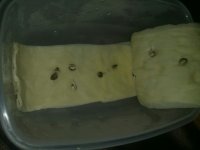
I chipped this seed two hours ago and it is already germinating.

Germination.jpg


Using this method I have managed to get high germination rates with really old seeds. People said that they got 0% germination rates with the Skunkman's oldschool Durban Poison x Skunk #1 freebies that were handed out with orders. Using this method I got about 75% of the seeds to germinate within a day or two.

It's a gamble but if done carefully it will work almost every time.

Method 2:

This is the safer option with less change of ruining the seed. It might take a little bit longer for the seed to germinate than with method 1 but still pretty fast compared to regular germination.

Use fine grain sand paper and carefully thin out the seed coat until it looks like there is only a very fine layer of the outer shell left. That's it.


Both methods increase germination rates considerably.


Keep it Green

-Kodiak-
Great post. :)

Helped me germ ~6 or 7 for 8 seeds that were germing very poorly with my papertowel method. I nicked the embryo on a few, and one or 2 didn't make it, but the seeds were otherwise poppin when the ones from the same batch were pretty much duds.

Thanks, Kodi!! :D If not for this thread, I prolly would have had only 1 go around with the Devils :^) I knicked em with an exacto, and put em in papertowels, and they were jumpin almost immediately. I let em go for ~2 days, just to soak the 'embryo condom', and got 5 plants, 4 strong enough to live.:D
 
my man sez:
seeds should be chilled, not frozen, to encourage germination. this is more effective on indica dominant varieties, probably because they come from colder regions. usually i just pull them out of the fridge and drop them in a shallow glass with tap water (chlorinated to help prevent damp-off). sometimes a light scuffing is in order. then i change the water daily and inspect the seed casing for changes.

this seems to work well for him, even though we mostly use cuttings.:D
 
Glad to hear it worked for you PatrickStar. That technique works great on any seed, even if they are fresh. Good luck with those plants :)
 
C .Ruderalis

Thanks L33t, that post from Sam the Skunkman shed some interesting light on the question. I never made the calyx to seed size connection, that would mean that the size of the seed is to some part at least, determined on the individual plane through the genetics expression of the parents and to what degree the female gets pollinated.

So in short, the female plant strives for larger seeds but seed size is ultimately determined by the degree of pollination by males. She compromises size for quantity. Lightly pollinated females would by this line of thinking produce larger seeds where "quality" once again comes to play. The F1 offspring of this lightly pollinated females will also display larger calyxes and big seeds, unless that female is in turn heavily pollinated by a new male. The F2's on the other hand will express the middle road of both parents. So medium sized seeds is probably the norm.

I think you are right about Indicas having bigger seeds, that might be because Indicas stem from arid regions whereas sativas are tropical plants. Humidity might play a big part in the way the seed genetics presents itself. In arid regions humidity might be low and the seed needs to retain more moisture inside the seed itself from the start, than seeds from plants that make their home in tropical areas. That would also mean that generally Indica seeds will take a little longer to germinate but they can handle lower levels of humidity while sativa seeds germinate faster but are more at risk of drying out.

How this relates to the thickness of the seed coat is anybody's guess.

I know that cannabis seeds mostly fall to the ground and if they travel longer distances it's probably birds that do the dispersion. That raises another question, how well adapted the seeds are in response to gastric acids. I mean, are cannabis seeds dispersed by birds or not? One would think that they have to be since it is so widespread, or maybe it's us humans that have dispersed the seeds along the planet. Cannabis has after all been used traditionally as medicine and for shamanistic purposes for thousands of years. Maybe the dispersion and genetic variety of this plant is mainly due to human use.

That's an interesting thought :)

Cannabis sativa is older than cannabis indica and c. indica is considered a subspecies of c. sativa but they must have had a common ancestor at some point and then split up into two different genetic expressions of that plant, which must be a geographical expression. My guess is that tropical sativas came first as the temperature and humidity at the equator is perfect for these plants. Then it traveled north and gave birth to indicas.

At first I thought that c. ruderalis must be a closer relative to indica than sativa, but this is not the case. Cannabis ruderalis is considered a subspecies of cannabis sativa. The term Ruderalis was originally used in the former Soviet Union to describe the varieties of hemp that had escaped cultivation and adapted to the surrounding region.

http://cannabisculture.com/articles/3033.html

Indica is also classified as a subspecies of sativa that made it's way up north by natural (or perhaps supernatural) means and gradually acclimatized through natural selection. Ruderlis is the other subspecies of sativa that was planted by us humans, later escaped and had to adapt much faster to the short days at the northern latitudes, giving birth to the low-thc hemp that autoflowers regardless of photoperiod.

I may be wrong on this but it makes a lot of sense.

I know a lot of testing was done on cannabis ruderalis by the super sativa seed club back inte the day as they were trying to come up with potent plants with short flowering periods. Some of these strains exist today, like ruderalis indica, ruderalis sativa and four-way. Since c. ruderalis is a close relative of c. sativa, one could propose that working with haze and ruderalis could eventually produce some interesting fast flowering hybrids that retains the potency of the parent, or at least something close to it. After all, the auto-flowering trait must exist in some degree in c. sativa too as c. ruderalis is a direct decendant of c. sativa.

Too bad no one sells pure ruderalis seeds anymore. There are some crosses from sensi that could be used and of course lowryders but it would be fun to start from scratch :D

I do not understand why people put down lowryder strains and c. ruderalis in general. They might not be the plant of choice indoors or at lower latitudes but up north they are about the only thing can can finish in time during the small window of correct photoperiod that lasts only six weeks or so. Besides, I think that working with ruderalis outdoors could be a blast, especially when crossing it to the most potent sativas and indicas around. Lowryders are fun but they leave something to hope for in height. Stuporsonic is just about the only 100% auto-flowering sativa out there but that also proves that it can be done.

The fact that a tropical sativa was able to adapt to a colder climate and an alien photoperiod over a relatively short period of time, speaks for the versatile nature of this plant.

I think that all varieties and expressions of this plant are good and important.

Just a thought

-Kodiak-

I also find the North, and I found the automatic incredible.
What did you think of Diesel Ryder, I will also make seeds ...
And I'll also try to introduce my character dan varieties.
Landraces of the pure sativa hybrid of Mr Nice.
Have you attempted to cross too?
 
I like all the Ryders. LR#2, Diesel Ryder and Blue Streak. I'm currently working with Madanzig's Sour 60, making some seeds.

I'll make F1's of all those strains and then start hybridizing them. Also looking at normal but fast-flowering indicas and some Danish outdoor strains.

I made a whole bunch of LR crosses before but I lost the seeds due to some legal problems.

This will be my last post on this forum. Thanks for contributing.

-Kodiak-
 
Last edited:
Thanks for the good vibes :)

I'm not gone altogether, I just moved over to Icmag. Same nick and profile pic.

Feel free to pay me a visit if you have something on your mind.

Keep it Green

-Kodiak-
 
Last edited:
this seems to be something a lot of people could do with reading. allot of people seem to be getting bad germination rates lately and i think could do with the help so i think i will had my penny's worth on this. here is a pic i took this morning of some seed i had soaking 3 weeks in wet tissue with a 0% germination rate. did i put them in the bin no i gave them a little help along by gently putting pressure on the seed till it popped open. then i put a sharp knife in the crack on the seeds and popped half the seed husk off and placed them back in some fresh damp tissue 2 days ago. i have had seed that have took 2 month to germinate so don't be to keen to put your seeds in the bin because they could have that very special plant in side that just needs a little helping start. and now whats my germination rate? 100%:D
 

Attachments

  • Half_husked_seeds.[1].jpg
    Half_husked_seeds.[1].jpg
    93 KB · Views: 25
seed germ :

-keep at 88-89 F
-scuff seeds with sandpaper
-not to wet, not to dry ( they need air too )
-I believe straight soil planting is best ( not paper towel method )


also keep it to minimum and simple wil yiled the best results I say
 
Anybody have an idea why seeds from one strain can be really small and seeds from another strain can be very large?

usually I see a pattern with sativa or indica influence .

looks at a haze seed and there really small, look at a kush seed and there fat.. other facts I do not know, but I do see these traits..
 
seed germ :

-keep at 88-89 F
-scuff seeds with sandpaper
-not to wet, not to dry ( they need air too )
-I believe straight soil planting is best ( not paper towel method )


also keep it to minimum and simple wil yiled the best results I say

i would say imoa that for old hard to germinate seeds the paper towel method give the best results. yes if you only wont the strongest and more vigorous plants to germinate then a 24 hour soak and straight in soil. but if you wont a good germination rate from bad seeds then a good sterile bit of damp paper towel will stop any infection from mould spores ect if sealed in a clean better wear tub and don't go daft wanting to check them everyday every 3 days is more than enough. i have just popped 26 out of 26 walkabout in 2 day like this and 5 out of 5 last week and the other 21 will go in pots tomorrow after a 62 hour soak in damp paper towel.
 
Last edited:
I recently germinated 25/25 Federation ISS I acquired in 2002. I have kept them in a small plastic bag meant for 1gram bags, which was then vacuum-sealed and kept in a refrigerated jar. After soaking in water for 2days there was only 3 popping root-starts. I placed the remainder, one by one, in my split-ring fishing pliers (which doesn't fully close) and gently cracked the seed along the longitudinal ridges, by applying slight pressure to both sides of only the seed's ridge line. This results in the opening of the seed tip, I then placed them midway, pointing down, in a et paper towel. I wrap the paper towel up in a flat rectangular strip and place the bottom in a cup of water. Overnight the cracked seeds grew root tips and 4-5 hrs later (when some elongation occured I placed the root portion in a root cube (some in dirt) with the seed mass above ground.
 
Back
Top