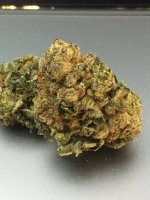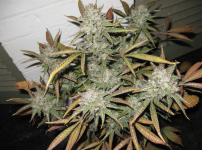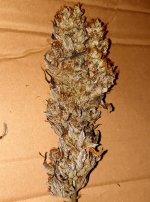
What are YOU smoking today? (PICTURES)

I’ve used Potassium Bicarbonate though I prefer Potassium Silicate. Citric Acid is relatively cheap on Amazon. Use 1tbsp/ 500ml.

mu
Did you use these products for PM or to get Potassium?
If used for PM, was it as a preventive or did you have PM before use?
If you had PM first, did it eradicate the PM completely or did you have to continue to apply it?

Lost Coast Plant Therapy
"In my limited experience, it seems to work much better if started early as a preventative rather than waiting until you are up to your asshole in alligators!" - Longball
"my experience is for early preventative .....agreed" Sb
https://mrnice.nl/forum/threads/the-other-half.17756/page-2#post-258640


2 other growers and I used Potassium Silicate religiously for 3 growing seasons. We had 100% success rate for getting Powdery Mildew on every single plant we grew every year using Potassium Silicate. Of course, this was not a randomized double blind study of thousands of plants over decades. It is simply what we experienced. Something else, perhaps a poor soil mixture, or nutrition, a different strain of PM could have affected how the plant reacted to the Potassium Silicate. Switching to Lost Coast(containing citric acid) as a preventive eliminated 99% of PM. Looking into the Powdery Mildew a little deeper as everyone has a different 'cure' for it we came up with this:

1) There are thousands of types of Powdery Mildew, depending which one you have may respond better to different treatment.
2) We grow outdoors, you grow indoors, we are exposed to more types of PM than indoor growers are.
3) You live thousands of miles away in a completely different climate. Again, you may have a different PM than we have.
4) PM is uncurable. You may bring it under control but the second you stop treatment it comes right back. We have a few members who can vouch for that. :( If you do get it under control and then immediately harvest them you mistakenly believe you cured it.
5) Companies who sell PM products claim they cure it. Scientists claim it is uncurable(safely). Only one of those two can be right.

"Powdery mildew is generally not curable in the sense that you can't completely eradicate the fungus from the environment, but you can effectively manage and control its spread and impact on plants using cultural practices (good airflow, sunlight) and treatments like milk sprays, neem oil, sulfur, or fungicides, focusing on early intervention and prevention for healthy growth. Prevention is key.'


Most likely you will need to try many things for PM to see what works best in your area. Or send a sap sample to a lab to check nitrate reductase and find out exactly what is needed. Outdoors, with billions or perhaps trillions of spores in the air it is a never ending battle.

Again, prevention is the key here.

"Potassium Silicate is best used before infection as it won't eradicate established mildew." (forgot the damn link)

These are just my experiences, not the World according Issac Newton! ;)
 
I use the products mentioned earlier along with Neem and H2O2 for PM treatment. It depends on whether plant is in early or late veg or flower or late flower. Product selection also depends on severity of infection. The right tool... I try not to get carried away with applying anything to my plants unless absolutely necessary. As you've mentioned, constant vigilance and immediate action are required. Spores are everywhere. For indoor growing, temperature and humidity are critical. When either varies outside of the "zone" is when I see problems arise. There is benefit to using different products and rotating them.
I like using products that have dual advantages. For instance kelp can help control infestation along with delivering nutrients. Likewise products containing K- potassium have benefits to plants. I've posted before about the benefits of K2SiO3- potassium silicate. This AI answer to my query which I have abbreviated sums up best why I especially like it: It strengthens plant cell walls, improving mechanical strength... This compound also boosts tolerance to environmental stresses such as drought, salinity, cold, and heat by improving water retention and regulating stomatal opening, thereby maintaining physiological functions under stress... Potassium silicate enhances plant growth and productivity by increasing chlorophyll production, which improves photosynthesis and accelerates growth rates... It improves nutrient uptake, particularly of potassium, phosphorus, calcium, and other essential elements, optimizing overall plant nutrition and supporting robust development... It also enhances reproductive processes, including pollination and pollen fertility, leading to improved yield and quality. Additionally, it reduces the negative effects of toxic elements like excess aluminum, sodium, and manganese, and helps maintain ionic balance in plants under salt stress... It acts as a natural fungicide, insecticide, and miticide, providing broad-spectrum, preventative protection against fungal diseases such as powdery mildew, root rot, and phytophthora, as well as pests like spider mites and whiteflies... Its use reduces reliance on chemical pesticides and fertilizers, supporting sustainable and eco-friendly farming practices... I use it regularly not necessarily for prophylaxis but for overall benefit to the plant.
I am not an expert by any means but like many of you, I do read and use products based on personal experience. When it comes down to it, the only additives I use these days is Potassium Silicate, Saponins, Humic/Fulvic acids and Recharge for the trichoderma to minimize pythium and other soil pathogens.

mu
 
Luckily PM is not a problem I have with weed. I do have it in my vegetable garden, normal under control with sulfur and copper which I don't use for cannabis.

I started trying out ash bleach (potassium hydroxide) as a foliar spray for pests and fungus in my citrus and other fruit trees as well as the vegetables and it does work for some fungus. It also keeps pests manageable. Net season I will use it for the ladies.

Cheers,
 
K2SiO3, yes exactly. take your time in veg. height is by no means the tell all sign to flip. Chop em down a bit if you have to, but make sure the root system's established before moving forward. co2 as well I find gets them in top shape where their own immune system makes pm inhabitable. I fought with pm for a while when I tried going all natural indoors and in pots... living soil etc. I'm assuming a lot of people go light on N for the sativa/hazes and while that may be fine outdoors and/or in soil tapering it too soon in a hydro/coco setup may be robbing the plants of its back bone (quite literally). Trying to force a sativa to behave/feed like 60 day indoor poly hybrid is like trying to fit a square peg in a round hole, and that's why problems like weak plants that just want to die end up with pm. humans can be so arrogant to think that nature will bend under their control, nature always wins
 
I used to have problems with PM. Now I maintain the humidity and temps within a tighter range and that has fixed it
Outdoors is a different story and I imagine upstate NY would present many challenges in this area.
It's bad enough where I am with this maritime climate. We have strong coastal winds and autumn rain.
The best option then becomes a greenhouse.
 
Last edited:
I use the products mentioned earlier along with Neem and H2O2 for PM treatment. It depends on whether plant is in early or late veg or flower or late flower. Product selection also depends on severity of infection. The right tool... I try not to get carried away with applying anything to my plants unless absolutely necessary. As you've mentioned, constant vigilance and immediate action are required. Spores are everywhere. For indoor growing, temperature and humidity are critical. When either varies outside of the "zone" is when I see problems arise. There is benefit to using different products and rotating them.
I like using products that have dual advantages. For instance kelp can help control infestation along with delivering nutrients. Likewise products containing K- potassium have benefits to plants. I've posted before about the benefits of K2SiO3- potassium silicate. This AI answer to my query which I have abbreviated sums up best why I especially like it: It strengthens plant cell walls, improving mechanical strength... This compound also boosts tolerance to environmental stresses such as drought, salinity, cold, and heat by improving water retention and regulating stomatal opening, thereby maintaining physiological functions under stress... Potassium silicate enhances plant growth and productivity by increasing chlorophyll production, which improves photosynthesis and accelerates growth rates... It improves nutrient uptake, particularly of potassium, phosphorus, calcium, and other essential elements, optimizing overall plant nutrition and supporting robust development... It also enhances reproductive processes, including pollination and pollen fertility, leading to improved yield and quality. Additionally, it reduces the negative effects of toxic elements like excess aluminum, sodium, and manganese, and helps maintain ionic balance in plants under salt stress... It acts as a natural fungicide, insecticide, and miticide, providing broad-spectrum, preventative protection against fungal diseases such as powdery mildew, root rot, and phytophthora, as well as pests like spider mites and whiteflies... Its use reduces reliance on chemical pesticides and fertilizers, supporting sustainable and eco-friendly farming practices... I use it regularly not necessarily for prophylaxis but for overall benefit to the plant.
I am not an expert by any means but like many of you, I do read and use products based on personal experience. When it comes down to it, the only additives I use these days is Potassium Silicate, Saponins, Humic/Fulvic acids and Recharge for the trichoderma to minimize pythium and other soil pathogens.

mu

I've used Potassium Silicate every single watering for 6 years for the exact same reason you do. It has lots of benefits. I just don't use it for PM.

"As you've mentioned, constant vigilance and immediate action are required. Spores are everywhere." - True dat! Plants don't get PM because they want to die, they don't have that level of consciousness to think such things. They get PM when the spores land on a place where they can grow and take root. How much N your plant has and how the plant processes it has a lot to do with whether or not you get PM. That is what the 'nitrate reductase' test is about.

A quick search in my area reveals that a nitrate reductase test is $20-40 and a soil test is $10-20. That's cheaper than Lost Coast half gallon and easier too!
Hmmm.....:unsure:

​

 
Shark Shock #1
full


More smoking, less talking ;)
MB
 
The taste is wonderful!! NL Kush Sensi Star vibes about it. Looking at the flower breaking it down, the undersides of the leaves and the calyx type and density, It's taste is the smell, like thats what it is.. It's perfume is 'teetering' on antiseptic or 'Patchouli' not TCP or cleaner, but with a touch of the Sour mash and hints of Garlic to it, very subtle, it's after taste is smooth and uplifting and tastes not like pure Kush, nor NL it's not SS. This is deffo one of the better older things compared to Dogg and the OG. You can Smoke this all day.. Or I could till I wanted something fruity. It's sleepy, the taste lingers nicely. It's bland enough to have some great top crosses going to it but it's not sexually stable.
 
All good @Swifty tastes like mid 90's Amsterdam. This is fairly fresh lower branch taster, going to cure the rest for a few weeks.
Looks the High AF goods.
All the SSH on here positively influenced me to withdraw a straw of SSH from the freezer today. Thank you all.

Here is a small bowl of NL5xAFG#3, the harvest after around 12 weeks flowering outdoor. Was the best, the 4 week earlier harvest to avoid mould from rain wasn't bad but this stuff was proper good.

04-01-2026 - nl5xafg 3.jpg
 
Back
Top