orangutang
New member
What I just wrote is what Nevil had to say, pretty much.


i wonder where the "cradle" of cannabis is, as africa is believed to be the "cradle" of human civilization.
comeon man thats not what its about is it ??
if it is , well your on the wrong forum ,
if everyone just had an ounce of respect for oneanother we wouldnt see posts like that , or hempy ruining threads like this ,
i throw my hands in the air in wonder at you guys , i really do ...
Its a bloody shameful display by apparent adults ,,
I thought it is considered to have evolved at the foothills of the Himalayas somewhere between Nepal and the Kashmir region of India/Pakistan/Afghanistan?
That would be your cradle!
Cheers,
Sensi
And you wanna report me for talking to BigHerb? WTF? Learn to stay outta people's way just like Shanti suggested at the end of my thread. TY.
I'm not mad at anyone. I have not threatened anyone with violence. I have not stated any homophobic comments (as above).
OK I won't ask Mr Big anymore questions because his article simply cannot be questioned without the anti-Hempy squad chiming in.
Mon fini ici. Merci et au revior.
Peace
GM1
piss off troll , we arent as stupid as you look , , your fake mr, innocent act does NOT work you were trolling him plain as day
you are a young punk and a very big annoyance
grow up or go away TROLL !

I would never swear to its accuracy but several pieces I have read said it is believed to have begun in what is now Turkmenistan and a couple other pieces just said in the general vicinity of the Caspian Sea, which is a large area, but then Turkmenistan is next to the Caspian Sea, so that is somewhat similar in claimed location.
I would be stunned if anyone is ever able to prove it's true region of origin.

a) Colombia - (0 to 10 north latitude)
Colombian Cannabis originally could be divided into two basic strains: one from the low-altitude humid coastal areas along the Atlantic near Panama, and the other from the more arid mountain areas inland from Santa Marta. More recently, new areas of cultivation in the interior plateau of southern central Colombia and the highland valleys stretching southward from the Atlantic coast have become the primary areas of commercial export Cannabis cultivation. Until recent years high quality Cannabis was available through the black market from both coastal and highland Colombia. Cannabis was introduced to Colombia just over 100 years ago, and its cultivation is deeply rooted in tradition. Cultivation techniques often involve transplanting of selected seedlings and other individual attention. The production of "la mona amarilla" or gold buds is achieved by girdling or removing a strip of bark from the main stem of a nearly mature plant, thereby restricting the flow of water, nutrients, and plant products. Over several days the leaves dry up and fall off as the flowers slowly die and turn yellow. This produces the highly prized "Colombian gold" so prevalent in the early to middle 1970s (Partridge 1973). Trade names such as "punta roja" (red tips [pistils] ), "Cali Hills," "choco," "lowland," "Santa Marta gold," and "purple" give us some idea of the color of older varieties and the location of cultivation.
In response to an incredible demand by America for Cannabis, and the fairly effective control of Mexican Cannabis importation and cultivation through tightening border security and the use of Paraquat, Colombian farmers have geared up their operations. Most of the marijuana smoked in America is imported from Colombia. This also means that the largest number of seeds available for domes tic cultivation also originate in Colombia. Cannabis agri-business has squeezed out all but a few small areas where labor-intensive cultivation of high quality drug Cannabis such as "Ia mona amarilla" can continue. The fine marijuana of Colombia was often seedless, but commercial grades are nearly always well seeded. As a rule today, the more remote highland areas are the centers of commercial agriculture and few of the small farmers remain. It is thought that some highland farmers must still grow fine Cannabis, and occasional connoisseur crops surface. The older seeds from the legendary Colombian strains are now highly prized by breeders. In the heyday of "Colombian gold" this fine cerebral marijuana was grown high in the mountains. Humid lowland marijuana was characterized by stringy, brown, fibrous floral clusters of sedative narcotic high. Now highland marijuana has become the commercial product and is characterized by leafy brown floral clusters and sedative effect. Many of the unfavorable characteristics of imported Colombian Cannabis result from hurried commercial agricultural techniques combined with poor curing and storage. Colombian seeds still contain genes favoring vigorous growth and high THC production. Colombian strains also contain high levels of CBD and CBN, which could account for sedative highs and result from poor curing and storage techniques. Domestic Colombian strains usually lack CBD and CBN. The commercial Cannabis market has brought about the eradication of some local strains by hybridizing with commercial strains.
Colombian strains appear as relatively highly branched conical plants with a long upright central stem, horizontal limbs and relatively short internodes. The leaves are characterized by highly serrated slender leaflets (7-11) in a nearly complete to overlapping circular array of varying shades of medium green. Colombian strains usually flower late in temperate regions of the northern hemisphere and may fail to mature flowers in colder climates. These strains favor the long equatorial growing seasons and often seem insensitive to the rapidly decreasing daylength during autumn in temperate latitudes. Because of the horizontal branching pattern of Colombian strains and their long growth cycle, pistillate plants tend to produce many flowering clusters along the entire length of the stem back to the central stalk. The small flowers tend to produce small, round, dark, mottled, and brown seeds. Imported and domestic Colombian Cannabis often tend to be more sedative in psychoactivity than other strains. This may be caused by the synergistic effect of THC with higher levels of CBD or CBN. Poor curing techniques on the part of Colombian farmers, such as sun drying in huge piles resembling com post heaps, may form CBN as a degradation product of THC. Colombian strains tend to make excellent hybrids with more rapidly maturing strains such as those from Central and North America.

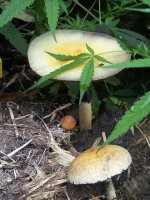
Maybe u guys should have some tripping grass to help chill out a bit, nothing else is working
What colour do the stems turn on those mushrooms when you pinch em kanga ?
Brings back a few memories ... I have some nice spores from ralph I should send you ..
 I have more of them in the patch than plants
Originally Posted by Brick Top View Post
I would never swear to its accuracy but several pieces I have read said it is believed to have begun in what is now Turkmenistan and a couple other pieces just said in the general vicinity of the Caspian Sea, which is a large area, but then Turkmenistan is next to the Caspian Sea, so that is somewhat similar in claimed location.
I would be stunned if anyone is ever able to prove it's true region of origin.
Hey Brick Top,
Funny you mentioned that because as I was waiting for my phone to charge I was thinking "hey, the Chinese are the first documented users of cannabis and the Himalayas are pretty big, lol, so it makes sense that the plant evolved on the other side"...then I get back on here and you posted this so looked at the map and sure enough, a huge plain/valley just east of there.
Also, prove is a strong word but scientist are pretty good and narrowing down a region and time that species evolved using genetics, natural history and fossil data. For example, there is solid evidence that the apple tree evolved in Kazakhstan.
Cheers,
Sensi
FFS, just a load of people fighting and hempy doing his crazy old loon routine, seems no-one cares about sorting fact from fiction anymore...