Nitrogen Deficiencies:
Plants will exhibit lack of vigor, slow growth and will be weak and stunted. Quality and yield will be significantly reduced. Older leaves become yellow (chlorotic) from lack of chlorophyll. Deficient plants will exhibit uniform light green to yellow on older leaves, these leaves may die and drop. Leaf margins will not curled up noticeably. Chlorosis will eventually spread throughout the plant.
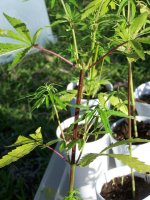
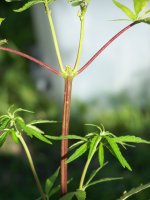
Stems, petioles and lower leaf surfaces may turn purple.
Phosphorus Deficiencies:
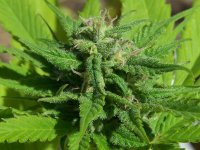
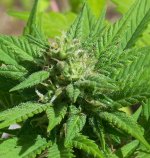
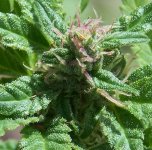
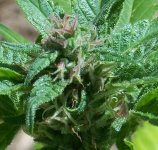
Figure 11 is severe phosphorus (P) deficiency during flowering. Fan leaves are dark green or red/purple, and may turn yellow. Leaves may curl under, go brown and die. Small-formed buds are another main symptom.
Phosphorus deficiencies exhibit slow growing, weak and stunted plants with dark green or purple pigmentation in older leaves and stems.
Some deficiency during flowering is normal, but too much shouldn't be tolerated.
Red petioles and stems are a normal, genetic characteristic for many varieties,
plus it can also be a co-symptom of N, K, and Mg-deficiencies, so red stems are not a foolproof sign of P-deficiency. Too much P can lead to iron deficiency.
Purpling: accumulation of anthocyanin pigments; causes an overall dark green color with a purple, red, or blue tint, and is the common sign of phosphate deficiency.
Some plant species and varieties respond to phosphate deficiency by yellowing instead of purpling. Purpling is natural to some healthy ornamentals. "
Link to full article with pics:
http://www.growfaq.net/growfaq/97.htm



 , although we both know folks like us, once current work is sorted, will keep making enough work to last the rest of our lives, wouldnt have it any other way


