Freezing Seeds

PennyP

Well-known member
Hey Brothers and Sistas, i have a question, I’m genuinely curious. Over the weeks and months and years I’ve collected a massive amount of seeds in my stash box—way more than I could possibly spark up today or tomorrow, or preferably tomorrow. Normally I just put them in my refrigerator at 3–4 degrees Celsius and let them sit there.

But lately I’ve been reading more and more that you guys put this stuff in the freezer. For several years. Is that a good way to do it? There are a lot of seeds that I bought, and I really don’t want to lose the genetics. From different breeders and seed banks—Mr. Nice, Sensi Seeds, etc... and my own stuff...

So yeah, that’s why I’m asking: is that okay? And how should I do it? Do I take them out of the blister packs and put them into a separate box and…maybe you can give a advice....never did that before...

And how i have to handle the Seeds after i get em.out of the freezer, when i want to grow them?

One Love Penny
 
Hey Brothers and Sistas, i have a question, I’m genuinely curious. Over the weeks and months and years I’ve collected a massive amount of seeds in my stash box—way more than I could possibly spark up today or tomorrow, or preferably tomorrow. Normally I just put them in my refrigerator at 3–4 degrees Celsius and let them sit there.

But lately I’ve been reading more and more that you guys put this stuff in the freezer. For several years. Is that a good way to do it? There are a lot of seeds that I bought, and I really don’t want to lose the genetics. From different breeders and seed banks—Mr. Nice, Sensi Seeds, etc... and my own stuff...

So yeah, that’s why I’m asking: is that okay? And how should I do it? Do I take them out of the blister packs and put them into a separate box and…maybe you can give a advice....never did that before...

And how i have to handle the Seeds after i get em.out of the freezer, when i want to grow them?

One Love Penny
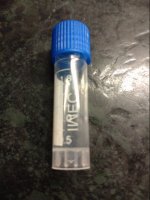
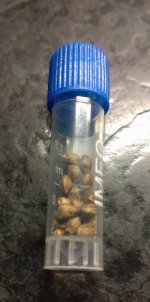
I use different kind of glass vials to store my seeds.
full

For the short term storage in the fridge I use the glass vial on the right and just put them in a plastic box at the back of the fridge.
For the long term storage in the freezer I use the glass vial on the left. I fill 1/3 of the vial with rice and put a sheet of coffee filter on top before I put in the seeds. On top of that I put a little cotton ball. I put the glass vials in a plastic box filled with rice in the back of the lowest drawer in the freezer.
When I want to use the seeds I take them out of the freezer and keep them in the fridge for a couple of days before I put them in the ground.
I have no scientific proof but so far it works for me (y)

MB
 
Hello @PennyP freezing seeds is pretty standard, you just need to make sure you do it properly. the number one thing to make sure of is that you have some version of a dessicant in it, so that something is absorbing moisture rather than the seeds. I was in the same boat, I always used to refrigerate my seeds, but like you I have ended up with such a collection they need saving of some kind so did some reading and found many people freeze their seeds.

I follow a similar process to Mr Brown, except I leave them in the original packaging if it is a mylar pack. For MNS, I took them out of the straw, added them to a vial and added some cotton wool to that. I added a small bit of cotton wool at the top of each vial. I then keep all of my vials in a layer of silicone crystals to absorb the moisture. I use a large mason jar to keep them all together then.

It could just be in my head and luck, but since freezing them I have had a 100% success rate so it is working for me.
 
So i have a Container like this i bought a couple of Weeks ago...when i Put sone corns of Rice in there and then some Cotton and then the Seeds and then some Cotton above them and then Put em in the freezer, do you think it works?

One Love Penny
5d88c17e-b185-4339-b1f4-b42c323ca660.jpg
 

Attachments

  • 41b9771d-c054-4a3b-aa65-d0229d1c8d6a.jpg
    41b9771d-c054-4a3b-aa65-d0229d1c8d6a.jpg
    1.4 MB · Views: 6
  • 7af2985d-33fa-426b-9e2b-a1aa49b7cd64.jpg
    7af2985d-33fa-426b-9e2b-a1aa49b7cd64.jpg
    788.9 KB · Views: 8
So i have a Container like this i bought a couple of Weeks ago...when i Put sone corns of Rice in there and then some Cotton and then the Seeds and then some Cotton above them and then Put em in the freezer, do you think it works?

One Love Penny
View attachment 108354
Yes mate it'll definitely work, but definitely also have something in the container that you keep them all in to absorb moisture. Rice is perfect if you don't have anything else to hand, as it works well and most people have it available 🙂
 
Hello @PennyP freezing seeds is pretty standard, you just need to make sure you do it properly. the number one thing to make sure of is that you have some version of a dessicant in it, so that something is absorbing moisture rather than the seeds.

Genuine question..... how is there any moisture available for the seeds to absorb at frozen below 0C, typical freezers around -18C?

At that temp, the "moisture" will be frozen and not available for the seeds to absorb? surely.

But I have seen shantis seeds with desiccant in it.

Is desiccant extra precaution for seed protection and peace of mind?
or is it really necessary for another reason?
 
Genuine question..... how is there any moisture available for the seeds to absorb at frozen below 0C, typical freezers around -18C?

Hello Ken Abbis! :)

You are correct. There is not and never will be moisture in a freezer kept at 0F/-18C. Frozen air holds little to no moisture. If you have kept food in a freezer long enough you will have expierenced freezer burn where the food has got dried out. You may have pulled a very dry freezer burned piece of meat of out a freezer but you will never pull a soggy piece of meat out the the freezer at those temperatures.

If you have a modern freezer that has a defrost cycle then as it goes thru the cycles the humidity does raise a bit. At 0F/-18C it can raise to 70%RH. Remember, cold air holds much less moisture than warm air. So 70%RH at 0F/-18C is equivalent to 4%RH at 70F/21.1C. A desiccant is never needed in a freezer. It is needed almost everywhere else though.

If you live in a cold climate in the winter, this is why your house is so dry and a humidifier is needed, there is little to no moisture in cold air. Freezers do not put moisture in objects, it pulls it out. A fundamental Law of Nature. Your seeds need to be packed absolutely airtight to prevent them from losing moisture.

LB
 
Genuine question..... how is there any moisture available for the seeds to absorb at frozen below 0C, typical freezers around -18C?

At that temp, the "moisture" will be frozen and not available for the seeds to absorb? surely.

But I have seen shantis seeds with desiccant in it.

Is desiccant extra precaution for seed protection and peace of mind?
or is it really necessary for another reason?
I believe that having the right moisture level within the seeds before freezing is the most important factor here.
When water content is too high within the seeds, freezing will turn that water into ice crystals and these will destroy cell walls => dead seeds.

Now this is the theory but in reality I would think that the seeds themselves are pretty good a regulating that on their own.
I would not be surprised that a seed would seal itself when ripening after reaching a proper low moisture level.

How would they survive the winter period outside?

I make bubble hash in the winter and I've seen this a couple of times:

Running material containing seeds was frozen, washed and the leftovers thrown outside on my small compost pile in the middle of winter.
After that there were several periods of frost and thaw.
In the spring I still see sprouts coming up in the compost pile and I know that these were the only seeds that made it there.

Moisture level is certainly important, sealing your seeds with a dessicant a few days prior to freezing should be more then enough imo!
 
Moisture level is certainly important, sealing your seeds with a dessicant a few days prior to freezing should be more then enough imo!

Remember, there is no moisture in a freezer at 0C/-18C. Scientific fact, not bro theory. If your container is truly airtight then the only moisture the desiccant can absorb is from your seeds. Most of us know bone dry seeds do not germinate well. If you are Dutch then you know your weather does not get down to -18C long enough to freeze seeds and pull the moisture out. The seeds natural moisture and your 'freeze'/thaw helped the seeds retain their moisture.

Your country simply is not cold enough to bother seeds.

"No, the Netherlands isn't considered a truly "cold" country; it has a temperate maritime climate with mild winters and cool summers, but it does get cold spells, wind, and rain, making it feel chilly and damp at times, especially with frost and occasional ice on canals, but extreme cold is rare."

Your personal observations are simply that. Personal observations of how seeds react in mild winters, not freezers. Ken was asking about desiccants in freezers not compost piles. "Genuine question..... how is there any moisture available for the seeds to absorb at frozen below 0C, typical freezers around -18C"

"When water content is too high within the seeds, freezing will turn that water into ice crystals and these will destroy cell walls => dead seeds."

This is a scientific impossibly as freezers suck moisture out of things. And how does a seed get 'too high' water content? When a seed is ready and drops it has the perfect moisture content to survive until next year and the first couple weeks of growing! Swifty, how does a seed get too high a water content? Look up 'freezer burn'. Things with moisture in them always get 'burned'/drier in a freezer, they never get wetter. Even ice cubes, which contain lots of moisture, when left in a freezer long enough will dry up. There will be no ice in the container. They did not freeze and get wetter as you suggest, they dry up. Most of us with freezers know this. Ice cubes don't get wetter and bigger, they dry up. Your theory holds no water.

Water can turn into ice crystals and destroy cells walls but this almost always when a cell is dehydrated rather than "when water content too high".

"As previously discussed, a common biological problem is dehydration.
Crystal formation upon dehydration can be avoided by forming a glass. Glasses are amorphous, and form by a continuous process (no interface or solidification front is involved). Their structure is comparable to that of a liquid (some short-range order is observed, but no long-range order), but their properties are those of a solid.
In response to dehydration, some living systems alter the composition of the cytosol in order to favour glass formation, for example by hydrolysis of starch to sugar. As can be seen on the sucrose-water phase diagram, the higher the sugar content, the higher the temperature at which a glass can be formed. Using this mechanism, complete dehydration can be survived."
https://www.doitpoms.ac.uk/tlplib/biocrystal/printall.php


In summary: Desiccants are not needed in freezers kept at 0F/-18C or lower as the air has literally no moisture in it. For this reason it will suck all moisture out of anything in the freezer. Nature hates imbalances so it tries to make everything equal.
 
Remember, there is no moisture in a freezer at 0C/-18C. Scientific fact, not bro theory. If your container is truly airtight then the only moisture the desiccant can absorb is from your seeds. Most of us know bone dry seeds do not germinate well. If you are Dutch then you know your weather does not get down to -18C long enough to freeze seeds and pull the moisture out. The seeds natural moisture and your 'freeze'/thaw helped the seeds retain their moisture.

Your country simply is not cold enough to bother seeds.

"No, the Netherlands isn't considered a truly "cold" country; it has a temperate maritime climate with mild winters and cool summers, but it does get cold spells, wind, and rain, making it feel chilly and damp at times, especially with frost and occasional ice on canals, but extreme cold is rare."

Your personal observations are simply that. Personal observations of how seeds react in mild winters, not freezers. Ken was asking about desiccants in freezers not compost piles. "Genuine question..... how is there any moisture available for the seeds to absorb at frozen below 0C, typical freezers around -18C"

"When water content is too high within the seeds, freezing will turn that water into ice crystals and these will destroy cell walls => dead seeds."

This is a scientific impossibly as freezers suck moisture out of things. And how does a seed get 'too high' water content? When a seed is ready and drops it has the perfect moisture content to survive until next year and the first couple weeks of growing! Swifty, how does a seed get too high a water content? Look up 'freezer burn'. Things with moisture in them always get 'burned'/drier in a freezer, they never get wetter. Even ice cubes, which contain lots of moisture, when left in a freezer long enough will dry up. There will be no ice in the container. They did not freeze and get wetter as you suggest, they dry up. Most of us with freezers know this. Ice cubes don't get wetter and bigger, they dry up. Your theory holds no water.

Water can turn into ice crystals and destroy cells walls but this almost always when a cell is dehydrated rather than "when water content too high".

"As previously discussed, a common biological problem is dehydration.
Crystal formation upon dehydration can be avoided by forming a glass. Glasses are amorphous, and form by a continuous process (no interface or solidification front is involved). Their structure is comparable to that of a liquid (some short-range order is observed, but no long-range order), but their properties are those of a solid.
In response to dehydration, some living systems alter the composition of the cytosol in order to favour glass formation, for example by hydrolysis of starch to sugar. As can be seen on the sucrose-water phase diagram, the higher the sugar content, the higher the temperature at which a glass can be formed. Using this mechanism, complete dehydration can be survived."
https://www.doitpoms.ac.uk/tlplib/biocrystal/printall.php


In summary: Desiccants are not needed in freezers kept at 0F/-18C or lower as the air has literally no moisture in it. For this reason it will suck all moisture out of anything in the freezer. Nature hates imbalances so it tries to make everything equal.
Very factual information on how freezing works Longball and correct!

My point was more directed on storing the seeds correctly, in the best possible way and making sure that they still intact for as long as possible.

I should have been more clear on why is said this.

-Airtight container, keeps the humidity out or in. Not meant for the conditions in the freezer it self. I understand the principles of freeze drying perfectly.
My concerns are more directed towards a failure of the freezer. You don't want your seed collection laying in a pool of water when you did not notice it stopped working for a time. This is always a possibilty one should take into account. If that would happen I prefer my seeds being in an airtight glass mason jar instead of being into a zip lock bag for example.

-Dessicants, As my example/ experience proves and as I stated above that I don't believe it being that important but If you want the best conditions for seed storage it is logical that maintaing a dry climate in your airtight container is important. If the humidty is high at the moment you put your seeds in the container this would not be optimal. Dropping a dessicant with your seeds and leaving them for a short time should balance the humidity inside the container thus favoring optimal storage conditions. That is all.

Hope it helps!

The Netherlands are neighbours here and a fun fact, coldest temperature recorded in my country was -30°C! 🥶
This is not where I live but we had up to -10°C. Not every winter ofcourse but I do recall a couple winters playing in the snow for weeks as a kid.:)

Greetings.
 
Sorry, I thought you were answering Ken's question about a freezer as you quoted him, not about storing seeds in compost.

My(Longball) point was more directed on storing the seeds correctly, in the best possible way and making sure that they still intact for as long as possible. That is exactly what I said. Not quite sure what you are blabbering on about. Most of what you said we learned in kindergarten. I see nothing we already didn't know. What was this you proved about desiccants? I missed it. Run that by me again, please. We all know seeds need to be kept dry. Repeating what I said is not new information. Most people store seeds in glass vials/mason jars. On an average year a seed storer's freezer will have less pooling of water than your compost pile. You are grabbing at straws here.

"I understand the principles of freeze drying perfectly."
More nonsense that has nothing to do with Ken's question that I answered quite clearly with source's posted. I understand freeze drying too and I would never do it to my seeds. As you know perfectly well, freeze drying is the removal of almost all moisture from the food/seeds. After freeze drying you can store the freeze dried food/seeds at room temperature. A special freeze dryer is needed do this. On the other hand most people already have a freezer. A freezer simply lowers the temperature of the seeds/food to preserve food in it's original state. Freeze-drying creates a crunchy texture and concentrates flavor, needing rehydration, whereas frozen food retains original texture/moisture but can suffer freezer burn, though both methods retain most nutrients. Again, freezing may possibly cause freezer burn(dryness), it does not add water to seeds and cause them to explode cell walls.

You are correct. Your country is not cold. The coldest temperature ever recorded in the Netherlands was -27.4°C (-17.3°F), set in Winterswijk on January 27, 1942.
The winter of 1941–1942 was exceptionally cold, considered by many meteorologists to be the coldest in Europe during the 20th century
, with some areas experiencing conditions potentially the most severe in over a hundred years or even centuries. Not sure how 1942 helps your case. It would take months, maybe years of that temperature to suck the water out of your seeds. Never happen.

"The coldest temperature ever recorded in New York State was -52°F (-46.7°C), set in Old Forge on February 18, 1979, marking the all-time low for the entire Northeast region." Now that's COLD.

While I have learned nothing about your ramblings of the things that may go wrong someday, it brings me great happiness to know that you have learned glass containers are better than zip locked baggies. :rolleyes:

That's it for me in this thread.

I know you are a person who must have the last word(prove me wrong), so have at it. I need a good chuckle today!

Greetings!
 
Hey there Penny.
You could also put all your vials in a ziplock bag and that way they are doublly protected from whatever wants to shorten their lifespan.
Which is now very long because they are frozen.

We could use the official procedures and protocols from the The Svalbard Global Seed Vault.
 
The Svalbard Global Seed Vault stores seeds in sealed, moisture-proof foil packets, placed in boxes on shelves within three large, temperature-controlled rock chambers, kept at a constant -18°C (-0.4°F), using both refrigeration and the natural cold of the surrounding permafrost for backup, ensuring long-term viability for future food security.

Seeds are dried and sealed in special four-ply foil packets, then placed in sealed boxes to block moisture and light.

The vault maintains a consistent -18°C, crucial for seed longevity, using artificial cooling systems.

The facility is built into the permafrost (permanently frozen ground), which acts as a natural freezer, keeping seeds frozen for weeks even if power fails.

Gene banks dry seeds to a precise low moisture level (often 5-8%) before sending them.

Seeds are sealed in multi-ply foil bags, then placed in sealed plastic tote boxes, effectively creating airtight units.

The storage rooms are kept at -18C(0.4F), which drastically slows aging.

The combination of sealed packaging and cold temperatures ensures low humidity, which is crucial for seed longevity.

While desiccants (like silica gel) are excellent for home seed storage to pull out residual moisture within an airtight container, Svalbard's professional system achieves this dryness before sealing and relies on the overall cold, sealed environment, making additional desiccants unnecessary within the final packaging itself, according to its operating procedures and technical descriptions.

That's all I could find out about that.
 
Interesting discussion.
@longball can summarise more please?
It’s a lot to read and discusses multiple points, and my attention span is short due to heatwave.
What I’d like to know is best method in old school freezer?
*no desiccants?
*glass?
*multiple layers of protection?
*fridge, then freezer, then fridge, then access?

I’ve been previously going, zip bags with desiccant in small amber jars all in larger Tupperware.
PS I’m aware of humidity when ever accessing stored weed and seeds 👍

I’d appreciate your info concisely

Thanks in advance
 
Everyone will tell you their way is the best. I am no different lol.

What you are doing will work for a number of years. I would make sure the amber jars and Tupperware are filled with 'something' to replace the air. Rice, cotton, rags, anything that fills in any air spaces. Store them in freezer. Most freezers are set at 0F/-18C. As Svalbard, @Ken Abbis, and myself say, there is no moisture in the air at that temperature. No desiccants are needed as the 0F/-18C will slowly dry your seeds. For access I grab what I need, the container is out of the freezer maybe 60-90 seconds. They won't unfreeze in that time. Make sure there are no air pockets, back in the freezer they go. Easy peasy.

If you are not using a freezer set to 0F/-18 or lower, you can bet your ass you'll need desiccants.
Multiple layers of protection? Yes.
Best method? A few more steps. You will be fine following the above.
 
Seeds are sealed in multi-ply foil bags, then placed in sealed plastic tote boxes, effectively creating airtight units.

The storage rooms are kept at -18C(0.4F), which drastically slows aging.

The combination of sealed packaging and cold temperatures ensures low humidity, which is crucial for seed longevity.

While desiccants (like silica gel) are excellent for home seed storage to pull out residual moisture within an airtight container, Svalbard's professional system achieves this dryness before sealing.

Hey Longball, you've kinda answered why I use desiccants with this message. To answer you too @Ken Abbis

Manage to post this by mistake as it is, so need to write the rest in a 5 min edit- quickly!

Basically, the short version of it is the humidity where I live is always 70-80%, so if I open the freezer, the air coming out might be low humidity, but the air that goes back into the freezer is high humidity.

Does your freezer never get frosty? Mine is very bad, especially if the door gets left open for more than a few minutes. I'd rather that extra layer of safety. My freezer also has a "defrost" function built into it, which ends up leaving a stream of frozen water running down the back of the freezer if it gets blocked.

The extremely short reason of using desiccants is it is like using a condom when the girl you're with is already on the pill. I really don't want an unplanned kid, id rather the double protection.
 
Last edited:
Back
Top