Searching old seeds for landrace genetics

Best of luck Marcus! I've read a few of these vintage threads before and its always extremely exciting to see what comes from the seeds.

Very informative posts from Big Sur and Musashi. Big Sur -I'm try to loosely follow the biodynamic intensive system learned through Alan Chadwick. Just prepping the beds with double digging has been immensely beneficial.

My personal problem with older seeds is that a majority will crack open in paper towels but then will stall once placed in potting soil. I will try spraying with h202 next time.

I germinate some relatively old "Vitality" (kalimist/destroyer x FLO) f2 seeds recently that were kept unrefrigerated for maybe 7 years and only got 4 out of 30 to emerge. 3 of them were slow growing mutants with weird leaves and splits. I did't think they would pull through but after 8 weeks they are finally growing normally and looking pretty sweet.

7 Years is a long time for seeds at room temps. 4/30 is actually a pretty good germination rate for seeds that old not kept dry and cold stored or frozen.

Yes, I prefer double digging to 'no till' myself. Stand back though, my landrace sativa plants can get to 15 feet tall here! Use H2O2 and you will get better results with germinating seeds, especially from older seeds. Soils are full of good and bad things that attack seedlings. I usually wait a little longer before planting my germinated seedlings into soil now than I used to. Usually the seed caps will have popped off by the time I plant them, and they turn green in a few hours under light. A good spray with the H2O2 and water and they are good to go.
 
If the lava doesn’t get you, the sulfur dioxide will. Vog is at all time high and with it respiratory problems. On the plus side no bugs on plants bc of the high levels of SO2. Headed for my place on the mainland til things improve.

Shaka
M
 
If the lava doesn’t get you, the sulfur dioxide will. Vog is at all time high and with it respiratory problems. On the plus side no bugs on plants bc of the high levels of SO2. Headed for my place on the mainland til things improve.

Shaka
M

Ah yes, fear the VOG! Main reason that they are evacuating people there. And the fact that now they think that the thing is gonna blow a big gasket real soon. (updated: it blew a small 30,000 ft ash gasket this morning).

Pray to Pele, the Goddess of Volcanoes. I bow to my Maui plants every morning.
 
Last edited:
BTW: There as a big fake news story here that said that experts feared that the PNW volcanoes would likely pop as a result of increased activity in the Hawaiian Islands. That is false. Hawaii is the result of a hot spot in the earths mantle, and Hawaii is in the middle of the thinner Pacific tectonic plate. The Cascade range here is being driven by the Juan de Fuca tectonic plate being shoved under the North American plate, and are the result of completely different activity. They are unrelated, and on completely different tectonic plates. Hence the increase in Hawaii volcanic activity will not increase volcanic activity here, as stated.
 
Last edited:
While Kilauea may be the most active volcano in the world, Hawaii also has the tallest mountain in the world as measured from its base. Mauna Kea, a volcano as well, rises to 33k feet. And yeah, the red soil here grows good herb. Flavors- it’s in da soil brah.
Safer footing on the mainland for now...

Aloha
M
 
@musashi - hope things are cooling off at home.

None of the seeds in my first batch of 15 turned into seedlings. I think a few had a chance but I let the paper towels dry out more than once. So here's what I'm doing with batch #2.

  1. Batch 2 comprises another 15 of the medium sized, brown seeds, which are the most abundant seed morphology type in this seed stash.
  2. Sanded seed shells with 320 grit sandpaper, focusing most material removal on the seam of the seed. Made a couple (smaller than batch #1) flat spots to encourage proper wetting of the seed shell and the seed germ.
  3. Mixing H2O2 solution of 1 cup 3% H2O2 to 1 gal H2O per Big Sur's recommendation and soaking the seeds in this solution for about 10 minutes.
  4. Remove seeds from H2O2 solution and place in aloe plant cutting for 24 hours.
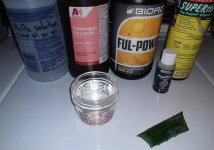
  5. Adding juice from the aloe cutting to 100 ml of the H2O2 solution, plus 1 ml Ful Power, plus 1 drop Rapid Start, plus one drop Superthrive and aerate in germination bomb for 24 hours.
  6. Moisten paper towels in solution of 100 ml water, 1 ml Ful Power, 1 drop RapidStart, 1 drop Superthrive (no aloe).
  7. Place seeds in folded, moistened paper towels and place in sealed zip lock bags which will be opened and exposed to air a couple times per day.
  8. Maintain at 70-75 degrees F.
  9. Manually crack seeds open if necessary.
  10. Transplant seeds with tails to Solo cups with perlite/sand mixture and spray seedlings with H2O2/Ful Power/Superthrive/Rapid Start solution.

I'm currently on Step 5 of the above process on batch #2. Hoping to find some old-school sativas!
 

Attachments

  • Batch #2.jpg
    Batch #2.jpg
    135.6 KB · Views: 34
I got some old beans recently in trade from a guy and he said they were only like 10% germ rate. So, I filed them lightly (2 strokes) just to scuff the resin and allow water to permeate. I decided to use the 1 cup H2O2 in a gallon of water for the paper towel wetting solution. I placed them in the wet paper towel inside of 2 plastic cottage cheese lids, and set them in a dark warm spot. So far, 4 out of 7 have germinated in less than a week! Pretty stellar for tired old seeds. The first one is now in sand and Perlite mix under lights.

Filing lightly is the key. No need to file heavy or deep. Just scuff the resin. Seems that they like the H2O2 solution as wetting agent as well. The H2O2 will dissipate pretty fast, leaving plain water after the H2O2 kills the pathogens.
 
Three weeks later, none of these seeds germinated but they may still be in play. I manually cracked them after about a week. They've been in paper towel wetted with the above germination solution inside a ziplock bag. Almost all of them show signs of active germplasm seeping out the seam, but they can't seem to muster the strength to fully split the shell. If you notice on my first batch the seed that shot out a little tail had been cracked wide open. I think that's what I need to do with these seeds...carefully open the husk halves. Another observation I made is that the seed in the photos below that is in the yellowish part of the paper towel seems to be more robust. The yellowing is aloe, and I'm led to believe that aloe truly does promote germination. I also wonder if they saw some light if that would help, so I have them under a window as I type this.

This post brought to you courtesy of Grail Widow #3. :D

Seed_batch_2_day_15_e.jpg


Seed_batch_2_day_15_c.jpg


Seed_batch_2_day_15_a.jpg


Seed_batch_2_day_15_b.jpg
 
Last edited:
My first two batches of 15 seeds each have failed to give me a viable plant. I've been travelling a bit lately and haven't had extended periods of time in which to play with seed germination techniques.

Today I began batch #3. This time instead of trying to pop the most common, normal-sized brown seeds that I attempted in my earlier efforts, I'm trying to germinate lighter green-gray seeds, including the three largest seeds from the initial lot of 100 seeds I separated from the remainder of my hippie seed collection. These all look to be in good shape and uncracked/unbroken. I scuffed them with 360 grit sandpaper and they are going to spend a couple days in an aloe vera cutting until they hit the germination bomb.

A note here on seed size. I've read (RC CLarke) that Thai seeds were very large. As Thai was rare on the east coast where these seeds were collected, and my brother (KT's ex) says he only ran across it once, I do not think these three large seeds came from Thai stick. But maybe these have Thai genetics? Have you guys been reading up on the Phylos discussions about Colombian genetics, specifically that the Phylos data suggests that Thai genetics may have been introduced into areas within Colombia? Perhaps that's an explanation for these three big seeds. I've also stated that there are quite a few tiny seeds in this stash. I've read that haze seeds are tiny. I do know that the pumto rojo x mangobiche seeds that I'm getting from my seed plants are also tiny, the same size as the tiny seeds in my hippie seed stash. I'm holding off on those until I can improve my success rate. Good things come in small packages, right? :)

So we'll see what happens here. But given my 0-for-30 success rate to date, I'm starting to do some research and preparation for germination by in vitro methods. I would appreciate any good information on these techniques anyone might care to share with me. Lots of info on tissue culture propagation from live plants, but very little about in vitro methods to germinate old seeds. As I understand it one must first sterilize the seed then extract the embryo (in a sterile environment) to place the seed embryo in the appropriate media. So I'll start practicing embryo removal on crappy seeds and look into buying, fabricating or borrowing a laminar flow cabinet. Wonder if I can find a local maker space that would have one. Instagram user test_tube_garden is a horticulture student who is selling kits; I've contacted him.
 
Bit of a quick post here. Mns has recently posted photos on instagram of in vitro seed germination. From the photos posted it looks like there is no need for embryo extraction and they are germinating under the right conditions. I am not sure if you have instagram but i will have a look into it and screenshot and paste the info here on the forums for everyone. They posted a link for more information that i will also post . I could be wrong.

Take it easy
 
Last edited:
podg-albums-screenshots-picture13383-vitro-seed-germination-mns-instagram.jpg


They said to check ISTA (international seed testing association) for all the relevant information

Hope this helps!
 
I don't have any solid science to back this up, but in my experience sativa' have small seeds and indica has the larger.
I've grown thousands (very conservatively) of each and from what I've seen you can gauge plant final size by the size of the seed. Small seed = huge plant, huge seed = small plant.
Granted that nothing in this life is set in stone, but it's a decent rule of thumb.

Largest seeds I've ever seen was blue satellite 2.2 that I got directly from breeder Steve (spice of life).
Smallest I've seen were from the old Santa Marta Columbian gold circa about 1977 (I spent some time down there back in that era).

For problem seeds I use the old pressure method
Small clear glass baby food type jar with tight fitting lid.
10 drops of 3%peroxide and 2 tablespoons of water.
Put seeds in cotton ball and twist it up so they stay inside.
Put jar in direct sunlight so it'll heat up and make pressure inside to force moisture into seed. Leave it like that until the sun goes down.
Remove from jar and place in ziploc and put somewhere warm, like 90*f or so (on top of modem or router).
Pray or otherwise genuflect to chosen deity :)

That's about all I got for ya.....hope it's worth something
At least a chuckle
 
I don't have any solid science to back this up, but in my experience sativa' have small seeds and indica has the larger.

Agreed 100%. My smallest seeds are Zac Purple/Big Sur Holy. They are tiny and grow into monster sized plants. My landrace Durbans also have small seeds, as do most of my land race sativas from Mexico and Colombia. The hybrids that I have been growing lately like Maui Waui Cherry Bomb have fat seeds.
 
Thanks everybody.

@Podg, thanks for finding that Instagram info from Mr. Nice Seedbank. I spent some time looking around in the ISTA web site and it's like looking for a needle in a haystack - lots of information there.

@n2ishun and @Big Sur, your observations are consistent with what I've read about seed size. It would seem to me that bigger calyxes make bigger seeds, so sativa breeders who selected for larger calyxes would be bucking nature's trend. The thing that threw me was RC Clarke's statement in MJ Botany that Thai seeds were very large - he must've been referring to the fat Thai sticks, not the good skinny ones. Anyway, like I said, there are a lot of tiny seeds in this collection and I'm saving those for last, because they're the ones I'm most interested in.

A general question: any suggestions on where I can access an in vitro lab? I don't really feel like investing the time and money needed to build my own lab and test my own protocols for in vitro germination. I've checked local makerspaces and none of them have that type of setup. I'm sure university labs and biotech companies have the facilities, and there are plenty of both in Massachusetts.
 
I probably don't have to tell some of you that RC Clarke is an idiot.
Pretty pictures and vague wording of old generalization of growing methods do not make an expert.
You can literally find errors in every paragraph he's ever written.

It was very difficult to find any seeds in the old small thai sticks. Just the way they were made caused the seeds to fall out, or off when handled.
I honestly believe the large sticks ( commonly called buddha sticks) were India in origin, but I think only the smugglers themselves would know for sure.
There was also loose thai bud, that was the chocolate thai, and man was it awesome.
This is where the majority of thai seeds came from. I have a solid stock of these, and they are tiny . They will go 20+ foot outdoors and take forever to finish.
Google up the "dr. Greenspoon" strain from barney's that's how it grows, but much much larger.
I have finished them outdoors in southern California, mid January to early febuary.
Consider a good Mexican or columbian will finish in late Nov to mid dec and that will give you something else to go by.
I am referring to old original land race stock and not modern selected or hybridized crap.

Bleh that's enough from me for now

Ps
In vitro means "in glass"
There is no magic performed, just lab level sterilization
The agar solution is expensive as hell (like 100 a litre) and that is just the liquid.
An in vitro baby costs like 20k, so I'd wager a seed would be like 2k?

With the age of your beans and the shitty storage condition I'm wagering none will ever sprout no matter how many sheep you bleed out on the altar
 
Last edited:
Agar is cheap at health food stores. Like $4 for a bottle of powder. Look to the mycology forums if you want to learn sterile technique with the stuff. ;)
 
I don't have any solid science to back this up, but in my experience sativa' have small seeds and indica has the larger.
I've grown thousands (very conservatively) of each and from what I've seen you can gauge plant final size by the size of the seed. Small seed = huge plant, huge seed = small plant.


I had never paid attention to this detail

very interesting
 
I don't have any solid science to back this up, but in my experience sativa' have small seeds and indica has the larger.
I've grown thousands (very conservatively) of each and from what I've seen you can gauge plant final size by the size of the seed. Small seed = huge plant, huge seed = small plant.


SEED ECOLOGY

Cannabis sativa reproduces by small, slightly flattened one-seeded fruits (classified as achenes), usually referred to as “seeds.” Haney and Kutscheid (1975) stated, “Seed production data probably provide the greatest insight to the ecology of hemp.” Wild (ruderal or weedy) hemp, almost everywhere it occurs, was derived from plants that escaped from cultivation in the past, and reevolved characteristics suited to wild existence. As detailed in the following, the seeds of wild C. sativa are remarkably suited to survival in nature by means of a number of adaptations. Wild populations that have been free from the selective influences of cultivation for many generations manifest extreme development of these adaptations, and conversely, populations only recently escaped from cultivation show only weak or no development of these features.


APPEARANCE

The seeds (achenes) of wild plants have morphological features that easily distinguish them from the seeds of plants that are cultivated, either for fiber, oilseed, or illicit drugs (Small 1975a; Figures 3.3 through 3.5). These features, discussed in the following, are clearly adaptive.


SIZE

In nature, all plants arrive at a compromise between the number of seeds produced and their size.
Like humans, some plants put considerable energy into generating a small number of progeny, which they very carefully nurture. Very large, one-seeded fruits like coconut, which provide a huge amount of “milk” for the embro, exemplify this. More typically, plants produce a very large number of quite small seeds in the expectation that only a few will find suitable habitats and escape destruction. Dandelions exemplify the extreme of producing a huge number of tiny seeds. Cannabis sativa is intermediate in producing a medium number of moderately sized seeds, by plant standards. The species has adopted a strategy that allows small plants to produce at least some seeds, and larger plants to produce many seeds.
The seeds of wild plants of C. sativa are smaller than those of domesticated plants (Figure 3.3).
Seed weight in C. sativa varies enormously, from more than 1000 seeds to the gram in some wild Asian plants to less than 15 seeds to the gram for some cultivated plants (Vavilov 1926b; Watson and Clarke 1997). Usually, the seeds of wild strains are smaller than 3.8 mm in length, in contrast to the larger seeds of domesticated selections. The ecology of the species may differ considerably according to the size of the seeds, and this remains to be studied. The smallest seeds occur in ecotypes native to alpine foothills of the Himalayas, possibly an adaptation to surviving at an ecological limit that is so stressful that it permits only a minimal amount of seed reserves to be accumulated before the plants expire. Large size of seeds in domesticated plants is usually the result of selection for a desired product in the seeds (frequently for food), but also, larger seeds provide a greater store of food reserves for successful germination and establishment. As discussed in Chapter 8 dealing with oilseed cannabis, larger seed size of domesticated seeds could be partly due to the practice of deep planting, requiring large vigorous seedlings to be able to grow out of the deep soil.


FIGURE 3.3 Achenes (“seeds”) of C. sativa (areas of attachment to the plant are uppermost). Left side shows two achenes of a domesticated plant, right side shows two achenes of a ruderal plant. The domesticated fruits are larger, lack a camouflagic persistent covering layer derived from the perianth, and lack an elongated attachment base that facilitates disarticulation in the wild form.

FIGURE 3.4 Comparison by light microscope (above) and scanning microscope (below) of attachment area of domesticated achenes (left) and wild (ruderal) achenes (right). In the wild fruits, a well-developed abscission area is present, and a basal “neck” that facilitates disarticulation is evident.


FIGURE 3.5 (a) Light microscope view of perianth (petal tissue) covering seed (achene) of a wild form of C. sativa. Notice that pigmentation (dark areas) is associated principally with vascular (fluid-conducting) tissue. (b) Scanning electron micrograph of perianth-derived achene covering layer; note areas of straight, aligned cells making up vascular tissue, and areas of nonpigmented areas (regions of cells with wavy margins). (c) Scanning electron micrograph of exocarp (fruit wall) of an achene of a wild form, showing portion covered by persistent perianth and areas where this covering has sloughed off. Photos from Small, E., Can. J. Bot., 53, 978–987, 1975.

SEED SHEDDING

In nature, plants reproduce mainly by distributing propagules, mostly seeds and fruits (occasionally vegetative tissues), commonly by wind, water, gravity, and cooperating wild animals.
Humans have domesticated many wild plants, frequently specifically to harvest the seeds or
fruits. Most wild plants cast off their seeds or fruits as soon as they mature, by various mechanisms. This has two undesirable consequences from an agricultural perspective: when a seed or fruit drops away, it is more difficult to collect; and when seeds or fruits do not remain attached to the plant at maturity, it necessitates repeated collection of propagules from each plant over the weeks that they sequentially mature. Selecting mutations that inactivate the separation mechanism (abscission, i.e., breaking away of fruits at their base so they fall away) or the dehiscence mode (i.e., opening of fruits to release seeds) with the result that the mature seeds or fruits remain on the plant greatly facilitates harvest. This reduction of “shattering” (natural shedding of seeds at maturity) is the most important way that humans have domesticated the majority of crops (Harlan 1995; Fuller and Allaby 2009). Cereals currently supply more than half of the calories consumed by humans (Small 2009), and in all of them, a “domesticated syndrome” of characteristics is recognizable whereby the “grains” (fruits technically termed caryopses) have lost the features in their wild ancestors that cause them to detach and scatter away (see, for example, Sakuma et al. 2011).
Although the precise anatomical and morphological features that facilitate release of cereal grains and the seeds of C. sativa differ, one can recognize a syndrome of seed characteristics that differentiate wild C. sativa from domesticated kinds of fiber hemp, oilseed hemp, and marijuana plants. The key feature enabling rapid release of seeds at maturity is the presence of an “abscission zone” (area of weak cells that weaken at maturity) at the base of the seed. At the base of the cannabis seed, one often views a circular scar (sometimes referred to as a “horseshoe” in European literature), the remnants of a plane of weakened tissue that served to disarticulate the seed from the stem to which it was attached. In conjunction with this feature, the base of the seed is often attenuated (elongated and narrowing), a characteristic that assists the seed to fall away easily from surrounding tissues of the infructescence (fruit-bearing portion of the plant). The combination of an attenuated base and a well-developed abscission zone in wild seeds (illustrated in Figures 3.3 and 3.4) facilitates disarticulation as soon as the fruits are ripe, and this is essential given the considerable predation by birds on seeds that remain attached to the plant.
In addition to the features described here, humans have selected seed-bearing crops that mature most of their seeds more or less simultaneously, to minimize harvest loss. As well, a highly congested fruit axis (adjacent seeds very close together along with bracts and young leaves) makes it very difficult for seeds to fall away from the plant and facilitates harvest of the seeds. A corn cob illustrates just how close together seeds can be packed and how most of them mature more or less simultaneously. These features are evident in plants selected for yield of seeds (as described in Chapter 8). By contrast, wild C. sativa plants mature seeds sequentially over a long season, and the seeds are relatively well separated so that they do not interfere with each other’s ability to fall off the plant.


PROTECTIVE THICK SHELL

In contrast to domesticated seeds, wild seeds have a comparatively thick fruit wall or “hull.” This (1) protects the seeds against mechanical abrasion; (2) makes it more difficult for herbivores to break open the seeds and consume the embryos; (3) makes it more difficult for water to penetrate, so that
the seeds won’t germinate and will remain dormant, providing for germination over several years; and (4) keeps oxygen from entering and degrading the storage oil. Possibly, the thick shell also serves to protect the seeds from being digested while they are in the gut of some animals, so that they will be deposited and germinate in the animal’s excrement, an environment to which cannabis is adapted.


CAMOUFLAGE

A camouflagic mottled layer covers the seeds of wild C. sativa, providing some protection for the fallen seeds against mammalian and insect herbivores. The layer is developmentally homologous with the perianth—the petals and sepals of many flowers. The dark appearance of wild seeds also contributes to their being inconspicuous. By contrast, as discussed in Chapter 8 dealing with oilseed cannabis, light-colored seeds have often been selected in cultivated plants.


"Cannabis A Complete Guide"
Ernest Small
 
Last edited:
Back
Top