Fem seeds and there impact on the future of the species known as cannabis.

  • Thread starter Thread starter hempy
  • Start date Start date
yes males can , when they produce female parts , so i guess strictly speaking it is an intersexed plant,, they can certainly pollenate themselves and produce seeds ...
most folks destroy the males in their grows , crops ,, ive grown many to and past maturity ,, and seen plenty of them show to be intersexed, many strains , not just one or two ...

Ive cloned males and kept the clones on 24/0 for use later. Usually just freeze the pollen though now
 
plenty of your males have shown to be intersexed. thank god you dont have the last ssh stud on earth lol only joking. So what is it then enviromental stress or preservation. So would you regard it a blessing or a nightmare? I have never seen a male turning sex naturally

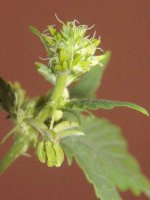
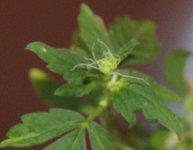
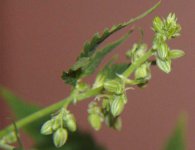
Here is a Blueberry male that had never grown anything but male flowers, after being alive a year it suddenly popped out some pistils. I was trying to find the best possible Blueberry male to work with and had put them through a battery of stress tests - irregular light regimes, irregular watering ,feeding too much, too litte, hell I even tried to give them all root rot to see which were most prone to it and I deliberately infected them with thrips and mites to see whch had the greatest resistance. This male passed all the tests then he was placed on a windowsill well away from my flowering space in order to collect his pollen, after a few days on the windowsill it suddenly starting growing female flowers, so what I think happened is the plant expressed a recessive intersex trait that only reared it's head once and after being in my garden for nearly 4 years
 

Attachments

  • P1010029.JPG
    P1010029.JPG
    37 KB · Views: 10
  • P1010032.JPG
    P1010032.JPG
    28 KB · Views: 6
  • P1010033.JPG
    P1010033.JPG
    27.5 KB · Views: 8
Those plants that went male were XY and got stressed by You flipping the light cycle back and forth.

And the person who grew barneys fems. I grew a Violator Kush and it was the worst weed Ive ever smoked in all my life (And Im an old man). It tasted like hard boiled egg yolks overcooked. I vomited every hit I took. I burried that plant, and the dogs didnt even dig it up.
The Barneys SweetTooth was pretty good. Buds not as thick as I would like, tho hard nugs. The flavor was wonderful, and the High was very instantanious and super strong. Headrushed real good. I would grow that plant just for the flavor and the High. Wish I had the original plant. It was probably awesome.
 
Here is a Blueberry male that had never grown anything but male flowers, after being alive a year it suddenly popped out some pistils. I was trying to find the best possible Blueberry male to work with and had put them through a battery of stress tests - irregular light regimes, irregular watering ,feeding too much, too litte, hell I even tried to give them all root rot to see which were most prone to it and I deliberately infected them with thrips and mites to see whch had the greatest resistance. This male passed all the tests then he was placed on a windowsill well away from my flowering space in order to collect his pollen, after a few days on the windowsill it suddenly starting growing female flowers, so what I think happened is the plant expressed a recessive intersex trait that only reared it's head once and after being in my garden for nearly 4 years

I'll bet that's got skunk in it. I found that (so called) skunk males, would do that if it was humid and stressed.
N.
 
I'll bet that's got skunk in it. I found that (so called) skunk males, would do that if it was humid and stressed.
N.

DJ Short calls them 'reverse hermies' and says they crop up in his Blueberry from time to time, a trait from one of the Thais in it's lineage.

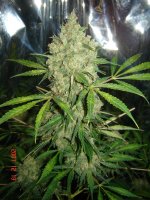
Here are some pics of a sister of that male in full bloom, does look like a skunk hybrid in some ways:

attachment.php


attachment.php


attachment.php


According to DJ Short, the breeding behind Blueberry is very complex, he has written several articles about it. He says that the P1s that went into making it were two different Thais, Highland Oaxacan Gold and an Afghan.

Here's the article DJ wrote explaining the breeding behind Blueberry, would live to hear what you have to say after reading this and if you believe him or not:

DJ Short - The Origins of Blueberry

Choosing your parents

The place for breeding to begin is with choosing the parent plants, called the P1 generation. For best breeding results you use true-breeding stabilized strains as your P1's. Different breeders have different standards as to what qualifies as a P1. I have very high standards for my P1 generation. For me, the P1 must be either a fully acclimated, region-of-origin land-race variety, or no more than one generation removed, and crossed with itself or another highly similar, region-of-origin land-race variety.

I used three P1 strains to breed Blueberry, Flo and others. They were the Highland Thai (also called Juicy Fruit Thai, a first-generation Thai seed grown in the Pacific Northwest); a cross called Purple Thai which was a first generation land-race Chocolate Thai crossed once with a first generation land-race Highland Oaxaca Gold; and an Afghani Indica which came to me one generation removed from Afghanistan via the California/Southern Oregon growing community.

Juicy Fruit
The Highland Thai was a joy to grow and behold, despite its hermaphroditism. This plant grew fast, filling in any empty spaces with lush, green growth. It was a very slow finisher, 12 to 16 weeks and beyond in the bud period for most. It had the longest and skinniest leaves out of all the plants I have worked with. Thick side-branching is another characteristic of this variety.

The plant only periodically produced any kind of "tight" bud structure. Most of the buds were very loose, with some sporting long, slender shoots of widely-spaced single female flowers in a row (especially when grown hydroponically under halide lights.)

This bud structure is known as "spindly". Many of these spindles resemble threads protruding from a semi-formed bud. Each single thread averaged anywhere from five to ten inches long, some even longer, and consisted of a row of evenly-spaced female flowers and their corresponding bract leaves, anywhere from a quarter inch to one inch apart, alternating bract and flower in single file.

Thai
The entirety of the "thread" and bud structure was coated with sweet/fruity aromatic resin glands.

The overall plant color was dark, while the bud structures matured a lighter shade of green, sometimes green/yellow.

I was never able to get a Juicy Fruit Highland Thai to "over mature". I took one to almost twenty weeks into its flower cycle and she just kept pumping it out. Outdoors, one was taken in early-mid December from a greenhouse. The only difference was that the later harvest was a more stony, body high.

The finished product from the Highland Thai was an all-around champion herb. Though difficult to trim and cure, the outcome was fully worth the effort. It was a powerful, long-lasting and exquisitely flavoured herb with little or no ceiling. The high could last up to seven hours! The flavour, aroma and taste were a totally sweet tropical punch – tutti-fruity all the way.

The Purple Thai was the other sativa in my repertoire. This was a first generation cross between the Highland Oaxaca Gold and the Chocolate Thai. This cross grew medium/tall and was very symmetric in structure. The side branches were shorter and, if left alone (untopped) the main stalk (meristem) remained the dominant shoot.


Afghani
The entire plant of the Purple Thai was very dark-coloured and would express a deep royal purple colour at the slightest exposure to cold. It did not exhibit any of the spindly bud syndrome of the Juicy Fruit Thai, and the finished buds were a medium and compact sativa type. The finished product was equally as fruity and strong as the Juicy Fruit, also without ceiling.

For whatever aesthetic reason, I preferred the Purple Thai to the Juicy Fruit Highland Thai. I believe that the Purple Thai was emotionally kinder or gentler than the Juicy Fruit. At larger doses the Juicy Fruit could evoke quite a terror, especially when combined with psychedelics. Though no less potent, the Purple Thai seemed easier to handle, including when tripping. The Purple Thai was one of the first to show resin gland production in the early bud cycle, at roughly three to four weeks into the cycle. It also matured at 10 to 12 weeks indoor, and early to mid November outdoors.

The Afghani Indica plant is short with large, wide leaves, stout and thick-stemmed. It has early to very early maturation, producing large, dense buds that smell earthen to skunk, with a strong smoke that is generally sedative or "down" in effect. Though consistent in its growth and overall effect, its appeal is somewhat limited in my opinion. I believe more indicas should be made into hashish, which is where the finer qualities of the indica appear.

Blueberry x Afghani
The sinsemilla Afghani Indica first showed up on the market in 1979. They were huge, green, stinky, sticky, dense buds of potent, pungent herb that smelled like a skunk and produced a narcotic-knockout stone that was tremendously novel, when compared to all the sativas that had come before. This was right after sinsemilla herb hit the market with big appeal.

The triad of sinsemilla, indica, and the advent of high powered halide and HPS lights, all wreaked havoc on the breeding programs of most pot-entrepeneurs. Few people maintained their sativa lines, and the strains virtually disappeared from the commercial markets. The short, dense, early-maturing and body-powerful indica has dominated the scene since 1983 – a matter of disjointed economics.

Such were the three main P1's I used for my breeding lines.

Afghani male

The f1 cross

The f1 cross is the first cross between two distinctly different P1 parents. The "f" stands for filial (child). I cannot overstress the importance of the two P1 parents being as genetically different as is possible. It is this initial genetic diversity that leads to the most possibilities in succeeding lines.

If the P1's are sufficiently diverse, then the f1 will be a true hybrid, expressing a near total uniformity and great vigor. It is in the crosses beyond the initial f1 (especially the f1xf1=f2 cross) that specific traits are sought. There will be a tremendous amount of variance in the f2 crosses of f1's obtained from a female pure sativa and a male pure indica.

The Blueberry (among others) was discovered and stabilized from an f1 cross between the P1 parents of a female Juicy Fruit Thai or a female Purple Thai and a male Afghani Indica. Thus there were two possible routes to essentially the same finished product. Blue Velvet and Flo seem more accessible via the Purple Thai route, while Blue Moonshine seems more accessible through the Juicy Fruit lineage. That is, there is a higher probability of occurence of the specific traits which I'm seeking, and so they're easier to "find".

Oddly enough, the opposite cross (female Afghani indica crossed with pollen from male Thai sativa) was not nearly as interesting. The f1's from this cross were more leafy and less desirable. They were also more hermaphroditic and subsequent breeding revealed them to be less desirable. It has been my observation that in a successful cross, the (usually female) sativa contributes the type of aroma and flavour, while the (usually male) indica contributes the amount of aroma and flavour to the prodigy. So far this observation has proven fruitful.


Blue Moonshine
So the Thai female is pollinated with the Afghani male and an abundance of seed is produced. The seed is uniformly sized and shaped; small, ellipsoid and mottled with dark stripes upon a grayish brown shell. A single female is capable of producing thousands of seed, leaving plenty for experimentation. This is the f1 generation, which I called simply "The Cross".

The plants of The Cross grew uniform, medium-tall "spear" structures of many competing side-branches around one main (meristem) stalk. Large, long buds formed along the branches. There was a wide palate of colours, especially among the Purple Thai cross. The buds were lighter, almost yellow to the centres, wile the outer leaf, bract and calyx tips showed red, purple and blue hues. The maturation rates were uniform as well, with a wide window of harvest being between weeks eight to eleven in the bud cycle, indoors. The finished bud had a very strong "astringent" chemical/terpene aroma that bordered between pine, gin, licorice and paint. Only a very few of The Cross expressed hermaphroditism, about 1 out of every 25 females.

Afghani
The f2 cross

The f2 is the second filial generation, simply a cross between any two of the f1 stock. With my f2 crosses the outcome was extreme, with almost every characteristic of the cannabis plant being expressed in some of the plants. The diversity was spectacular, both in structure and aesthetics. From sativa to indica, short to tall, dark to light, early to late maturation, wide to narrow leaves, along with an extensive array of flavours, aromas, tastes and highs. The f2 seeds collected were equally diverse, ranging from large to small, plump to slender, striped to solid, round to oval.

A grand amount of time, energy and money was spent from this point to isolate and stabilize the desired traits. There is a tremendous amount of work between the f2's and the f4's and f5's. Trial and error is the rule; certain paths prove futile while others bear further examination. On average, there are about nine errors to each success. Coupled with the difficult clandestine aspects of the trade through the 80's and 90's, it was a difficult task to accomplish. Many sacrifices were endured by my family and friends.

It was however, a fun and worthwhile occupation to sample all the research material. It was hard work and dedication to record the findings and attempt to create useful categories and find patterns and traits to specific characteristics. Then there's the wait for the cured sample. If the sample passed "the test" then the plant was kept for further consideration. The most desirable samples were used for further breeding to f3, f4 and f5. The harvested plants, cut above the lowest few nodes, were placed under a vegetative light cycle to stimulate new growth for cloning.

Blueberry x NL#5
I like to do one backcross somewhere between the f3 and f5 generation. Exactly when, where and how that is done remains a trade secret for now. Another trade secret is the art of selecting the best males for breeding. These topics and others will be covered in future articles.

Have phun!


Select the best, reject all others

Mendelian procedures are fine for sweet peas, but when it comes to herb I much prefer Luther Burbank's philosophy: "Select the best and reject all others!" This simple phrase is worth much consideration. Mendel's work is useful, especially concerning P1 and f1 crosses. But beyond the f2 and f3 cross, Mendel's theories add copius complexity to the equation.

Afghani clones

Your friend the freezer

A benevolent tool in our trade is the refrigerator and freezer. The fridge is extremely useful in extending the longevity of seed and pollen. The trick to successful freezing is to freeze deep (-10 to -40°F/-20 to -35°C) and then keep the seed undisturbed. Hard frozen objects are very fragile. The slightest shock may shatter crucial, delicate cell structures within the seed. Double wrap the seed in paper; little manilla envelopes work great.

I like to do small amounts, in one-time-use packets, to keep waste to a minimum. Then place the wrap into a plastic freezer bag, then place the freezer bag into a plastic tub or tupperware container. Now the seed is ready for the deep-freeze. In the fridge, storing seed in airtight, brown glass jars with a little rice or other non-toxic desiccant seems to work best.

I have had pollen last for years in a deep freeze. It must be frozen immediately after fresh collection from the plant, in as low a humidity as possible (preferably 0%). I like to shake the productive male flowers over a flat and clean piece of glass. The pollen pile is sifted to rid the unwanted plant material from the pure powder.

It is also useful to cut pollen with flour to stretch the amount. A pollen-to-flour ratio of 1:10 or even 1:100 works best. The cut pollen may then be separated into small, one-time-use amounts, stored in a flap of paper and frozen the same way as the seed. The frozen pollen must be applied to the live female flower immediately after thawing to increase viability.


Blue Velvet
The sweet sativa room

I recommend the creation of a special "sativa room" for indoor breeding of such strains. This room needs to consider and satisfy the unique needs of the sativa variety. The goal is to replicate the equatorial conditions of the world’s various "sweet spots". Some of these conditions include: a different light cycle than the standard 18/6 vegetative 12/12 bud cycles, a higher angle of light (using a straight track shuttle instead of a circular one), humidity control set on low for the highland and high for the lowland, and variations in soil composition and depth.

Light cycle is one of the key considerations for those wishing to breed truly fine quality cannabis indoors under lights. The 18/6 veggie and 12/12 bud cycles are perhaps the main influence towards the indica dominant strains and generic blandness of the indoor commercial product. A true equatorial sativa will require closer to a 13/11 vegetative and a long (four to six month) 11/13 flower cycle. Different variations may be tried, such as 15/9 veggie and 10/14 flowering cycle. Be prepared for much fine tuning.

Equatorial strains also experience a higher arch of sunlight than those grown beyond 38° north or south – with a sunrise almost due east and sunset nearly due west. Therefore the sativa room will edintense overhead lighting with a straight track mover. Keeping the plant in a stationary position, especially through the bud cycle, may positively influence the outcome of the finished product.

As jungle (lowland) herb requires only a thin layer of nutrient soil, perhaps a four-to-eight inch layer of soil over clay or concrete (with some form of drain system) would encourage lateral root growth, stationary plants, and a more lowland sativa-friendly environment.

If successful, the sativa-friendly room can be used to acclimate an indoor sativa variety, which expands the possibilities of your breeding operation.

DJ wrote a book a few years ago and on the cover is a Oregon Purple Thai leaning pheno from his work, looks rather unusual:

homestead%20002.jpg
 

Attachments

  • DSC02929.jpg
    DSC02929.jpg
    277.5 KB · Views: 1,734
  • DSC02930.jpg
    DSC02930.jpg
    282.8 KB · Views: 2,371
  • DSC02931.jpg
    DSC02931.jpg
    251 KB · Views: 1,099
British I have to tell you Dj doesn't have the answers. Last I heard he was against using hormone treatments to make gynoecious releases.

His populations were maintained in pitifully small populations. What was it 40 to select from in the mobile homes? Self admitted, publicly.

Why do you think he only uses one male to maintain all of his "strains"? Oh, so flo has been half blueberry for every generation? How does that work? Oh, now you lost the male (trueblue and f13's dad) well you better cross the one you have that fathered all your old populations(delta 9 releases) and charge us $150 for vanilluana and the others. UGH!


Also earlier you seemed to confuse a 'recessive trait' with one that only is activated in certain environments. If you grow a female individual for years and then one week your light schedule gets messed up and she reverses sex or pops nanners it doesn't mean her intersex traits are recessive. Recessive traits require homologous chromosomes that in any other matching (aka Aa, or AA) would be masked....
 
Last edited:
Yeah, I always had my doubts about DJ, the old 90s Blueberry that I had was amazingly good, the new one is totally different and nowhere near as good. I've seen and grown a lot of his stuff and the variation in all his lines is huge, some fantastic smells and tastes and highs but many bad characteristics too, apart from that old 90s Blueberry none of his stuff has impressed me enough to keep around, sure the end product is conoisseur quality but in other regards such as yield, vigour, structure and others there are major issues.

Personally, I have my doubts about his lineages too, so many people tell me that there are some very old Afghanis on the West Coast that reek of Blueberry, things like Dabney Blue, Oregon Blue and Blue Dot. DJ has never shown pics of the Afghan he used or said much about it apart from saying it was a 'stretch indica'. I suspect strongly that DJ never created the Blueberry smell/taste by careful selections other decades of work, I think he just took one of those Blueberry smelling Afghani cuttings and crossed some sativas into it to add more high effect and variation in flavour, but I might be wrong.

All in all, I respect the quality in terms of smoke that I've seen from DJ's lines and how exotic and unusual they can be but have a great deal of disregard for the way the things grow, Flo for instance, superb end product but a PITA to grow, incredibly finicky and picky about feeding and watering, has very little vigour, yield is terrible on the purple phenos, stems are thin and woody making it hard to clone. I think other people have made some better 'Blue' lines than DJ, such as Shiskaberry and Chimera's Blueberry crosses. Most damning of all, if you want a great Blueberry today, the best place to look is in Joey Weed's f2s of the original 90s Blueberry, not the DJ Short contemporary Blueberry you can buy today.

When DJ gave him Blueberry mother to some Cali dispensaries I was expecting it to be like the old 90s Blueberry but all the reports I've seen make it clear it's nothing like the 90s one and most people I know who have grown it weren't impressed with it at all, and this is supposed to be DJ's personal cutting he's kept for a very long time.

Something just doesn't add up about it all, but as I don't know the guy personally I have no real insight into the truth.
 
Didn't the blueberry come from bubblegum, which IMO was 50% SK. If you substitute super Skunk with afghani, I think the picture becomes clearer. Anyway just look at the plant, it's got SK1 and SuperSk written all over it.
N.
 
We have the indirect evidence that it's not a sex linked trait. So in your mind is it on the X or the Y or both. And what direct evidence do you have indicating it's not on the autosomes.
IMO it's linked to the X, but I have about as much evidence as you have that it's autosomal. Which indirect evidence are you referring to?
We're guessing and that's about all we can do without evidence.
N.
 
Those plants that went male were XY and got stressed by You flipping the light cycle back and forth.

And the person who grew barneys fems. I grew a Violator Kush and it was the worst weed Ive ever smoked in all my life (And Im an old man). It tasted like hard boiled egg yolks overcooked. I vomited every hit I took. I burried that plant, and the dogs didnt even dig it up.
The Barneys SweetTooth was pretty good. Buds not as thick as I would like, tho hard nugs. The flavor was wonderful, and the High was very instantanious and super strong. Headrushed real good. I would grow that plant just for the flavor and the High. Wish I had the original plant. It was probably awesome.

not true at all unless your saying Shanti's stuff hermies that easily ,,, I did not flip them quickly back n forth , im 38 and been around male and female plants my entire life , my parents grew too

i know a male a female and a hermie , my female was just that , A FEMALE , it turned MALE not HERMIE , so please explain without the bs light flipping hermie creating stress because this is no stressed plant other then the light flipping , that was done over time not quickly
 
Intersex: A condition in which a plant (or animal) displays functional sex organs of both genders. Easier to type than hermaphroditic. My belief is that almost all hermies are genetic females that have weaknesses in their ethylene signaling pathway, which makes them very susceptible to environmental stress.

Stress: Any environmental factor that causes a response by the plant. Stresses can be biotic or abiotic. Biotic stresses include insects, fungi, viruses, predators, and CAMP. Abiotic stresses include drought, poor soil conditions, extreme wind or humidity, or hurricanes or flooding. Both types of stresses can have large effects on phenotype, including induction of intersex phenos.

I dont know much about breeding but i honestly think enviromental stress and or sexual frustration that causes hermis is closely related to intersex types. If intersex was genetical (genetics determined by enviroment) then why does it not show up as soon as you put it into flower. Does intersex occur in wild outdoor canna plants grown in its own enviro. If i went to afghanistan and brought back an afghan plant and took it home to grow indoors would the shock be enough to have it switch sex?. A change in enviroment can only iduce intersex my 2 cents
 
what i dont get is that my plant never once showed male and female at the same time , it was 100% either way but never a mix

ive seen others in other forums claim this recently too so would like to figure out WTF :confused:
 
it went in as a mature seed plant , waited long enough to find out yes its female , then went back to veg for a good month before taking clones

the clones all showed to be male , so i flipped the mother and she too showed to be male , i killed it , but did keep it alive in a stand up shower long enough to see if it ever showed female flowers too but it didnt , as the male flowers started releasing pollen i killed it

i do have one living clone from it vegging , if anyone knows a use for it or good reason for having it ill keep it around
 
Sounds like it could well have been a male all along but had a intersex trait and grew some female flowers early on as a result.

I have not seen that precise thing as far as I remember but I have seen a plant do the opposite - grow balls when first sexed then was cloned and put back into veg to regenerate then when flowered a clone it was all female. This happened with the very first Colombian Gold plant I had and is the only occassion I have seen a lumbo from that line show any signs of intersex.

I don't claim to have the answers but I think they lie more in the realms of reality and are to do with intersex rather than in the realms of fantasy and involve mysterious sex changes.

Wish I did have the answers but as it's been said before, we don't fully understand the sexual mechanism yet.
 
Didn't the blueberry come from bubblegum, which IMO was 50% SK. If you substitute super Skunk with afghani, I think the picture becomes clearer. Anyway just look at the plant, it's got SK1 and SuperSk written all over it.
N.

Well, the Bubblegum cutting from Indiana was supposed to be an old Afghani, it travelled to Holland in the early 90s, I expect it was hybridised with Skunk in the land of wooden shoes.

Friends who have grown both the Dabney Blue from the West coast and the Indiana Bubblegum tell me they are very very similar, impossible to tell apart in veg and almost identical in flower.

If, as I strongly suspect, the Afghan DJ used was Dabney Blue or something very similar, then that would explain any similarities between the Blueberry and Bubblegum seed lines.

I completely agree about the looks of that plant I showed, very skunk in appearance, but the smell and taste were nothing like a Skunk, it was all floral/berry and very complex.

Have to say, that plant, while representative of what the old Blueberry was like, isn't typical at all for a modern Blueberry.

Nothing about Blueberry has ever made much sense to me, if it weren't such great weed I'd have avoided it due to the confusion.
 
No, it's an old Afghani cutting from Indiana.

Shiskaberry is Afghan x Blueberry, awesome strain, wish I could find more beans of that one, I forget the precise Afghan used now but it was one of the ones I mentioned that smells of blueberry muffins such as Oregon Blue, Dabney Blue etc. Shiskaberry has way mor blueberry smell and taste than DJ's Blueberry.
 
Hey again BH.
I'm not sure if you were kidding about me being hoosierdaddy or not, it is hard to determine if someone is being sarcastic in this binary world. I prefer to use a sarcastic font.

I don't know who hoosierdaddy is but have heard the name brought up a couple times whenever people start insulting each other, so I assume YOU are insulting me. I find this discouraging as I thought you had more to contribute BH.

Back to the topic. I'am yet to here from Chimera on this one so I will re-state it in hopes to see what his view about this is.

My personal experience is as follows:

I selected males to make seeds with. The males that I use have NEVER shown female characteristics. I move every year and set up new rooms. My moms and dads are abused (weird lighting, temperature and ventilation especially) while setting up each time and the moms will get "querky." My LUI mom gets weird EVERYTIME as do other moms consistently. But NOT the dads I selected EVER. WHY? 25 years of this and just the ladies.

Are Nevil and myself the only ones on the planet left with non intersexed males? If thats the case thank NVL that Nevil kept his cause I'm just a dude with a closet.

Waiting for Answers,

KB

PS - Attack me all you want I'm ex-military and ex-Reagan administration, I'm done fighting. The only things I defend now are my family, my garden(s),mother natureand those who can not defend themselves. My name means nothing, all I care about is the work.
 
Back
Top