Good change of discussion. I’ve had Nikons since the 80s. I drifted away from 35mm cameras, last was my D90 and D70. I started using smaller Lumix pocket size as I was travelling a lot.

I have a smaller Lumix LX-7 w/Leica lens. Great little camera.
. My desire was to get a Nikkor micro which after a year I finally found an excellent 105mm 2.8. Still on the learning curve with it, haven’t mastered Longballs depth of field achievements yet.
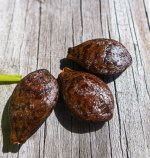
Now I’m already down the upgrade wormhole. d850 is bit pricy, so I’m looking for. D800(e). Can be found in good nick low shutter count for about 5-600$US. Anyway my final goal is play with my PB6 bellows. I have all the fittings to mount lenses backward, potentially reaching over 20x life size. Extreme magnification. I also want to document seed size, colouration and patterns, as I love growing them.
@longball can I request shutter speed and aperture info with you photos please? E.g. post 860. I think it may help me on my learning journey.
The Nikon D800E and the Nikkor 105mm 2.8 is a GREAT combination! The closest the 105mm can get to a subject and still focus is 12.36 inches from the sensor. Not the end of lens but the sensor. At home I have a little stick I measured. Some times I take it out or measure something out there. Manual focus will always get you a sharper picture.
Here are some things to know for anyone looking to shoot macro.
A 1:1 macro is reasonably hard to shoot with. When you introduce magnification the depth of field becomes impossibly small and nothing seems to be in focus. Using bellows or magnification of 5X or 20X is GREAT for taking pictures of stamps, credit cards, table tops, snowflakes, things that are very, very flat. For this reason a lot of brand new magnification lens can be bought on Ebay for 10 cents on the dollar.
Another big problem with shooting macro has to do with the Laws of Light and of Physics called 'effective aperture'. When shooting at close distances and high magnifications (1:1 or more), the lens elements extend, increasing the distance between the lens and the sensor. This extension changes the true light-gathering ability of the lens, and consequently, its effective f-number. The displayed f-number on your lens is calibrated for infinity focus. The effective aperture is calculated using the formula: Effective f-stop = f-stop x (1 + Magnification).
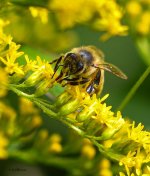
If you're shooting at 1:1 magnification (1.0x) and your lens is set to f/8, the effective aperture is f/8 x (1 + 1.0) = f/16. If you're at 2:1 magnification, your effective aperture becomes f/8 x (1 + 2.0) = f/24. So on the picture of the bee my camera was telling me my aperture setting was f/3.2 The truth is my camera was using an aperture setting of f/6.4 Of course, aperture is tied into your shutter speed. An aperture of f/3.2 requires a different shutter speed than an aperture of f/6.4 This is part of the reason why I shoot in manual mode. The camera will always try to take 'the perfect daytime picture'. In manual I can take the perfect picture for the light available. All light is not 'perfect daytime light'. Like at sunset.
If you are going to shoot at 20X magnification with an aperture of f/11 for a good depth of field you will actually be shooting at f/231. Your picture will be pitch black unless you have a whole lot of light and also a tripod using a long exposure. I am VERY interested in seeing your pictures taken at 20X.

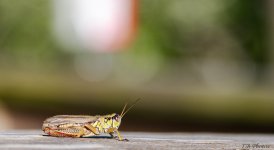
In post #860 the bee was shot at /f3.2(really f/6.4 due to effective aperture), Shutter speed 1/400th of a second, ISO-100. For grasshopper picture only difference is Shutter speed - 1/100 of a second.
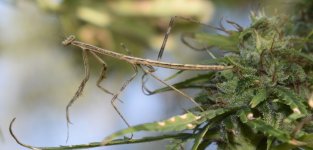
I also put Praying Mantis on my plants when I find them. Often times, they are already there.

We have a lot of Daddy Long Legs spiders here and I also put them on the plants. I rarely have any bug problems.
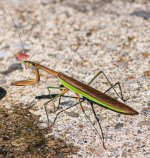
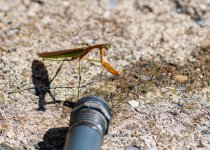
For this picture of a Praying Mantis the aperture was f/4.5(effective aperture was 9.0 for nice depth of field on the mantis), Shutter speed - 1/500th second, ISO-100. All pictures shot in manual mode.
One last tip - always shoot macro in RAW file format. It is ok to shoot macro in .JPG format as long as you are comfortable with the fact that you will never get the picture you really want.
Longball