
You are using an out of date browser. It may not display this or other websites correctly.
You should upgrade or use an alternative browser.
You should upgrade or use an alternative browser.
CBD#1 Test grow - organic,indoors, LED lights
- Thread starter podencoid
- Start date

podencoid
New member
Hey Bigdog - I finally got hold of a test kit and found the time to us it over the weekend. However, I didn't test the cannatonic! Lol!
I still have some of it left but all three plants ended up in one jar - one of the plants was particularly 'lemony' smelling so maybe I can pick that one out and test it shortly.
I am very fond of cannatonic - We have been making edibles out of it mostly. Subjectively, I would say all three were high CBD, low THC, certainly no high THC phenos in there.
Actually, we gave some to two of our dogs with very positive results. Our oldest dog stole a number of coconut oil sweets made with Cannatonic and didn't seem to suffer any ill effects, in fact he was the most cheerful we had seen him in some time. Another of our dogs (we have 8 at the moment) had a pinched nerve in her back so, after seeing that it was safe, we tentatively tried her with some coconut oil Cannatonic and she also did very well with it. Mostly sleeping and feeling much less pain. Not too 'out of it' but definitely more relaxed and content.
However, I would only recommend giving a high CBD strain to dogs and even then extremely cautiously - I'm very reluctant to recommend it without expert advice. This kind of started by accident.
Back to the test results - I tested all ten female plants grown from the test seeds and one high THC strain for contrast - all ten plants showed very regular and balanced amounts of CBD/THC. I am having scans of the test plates checked by the guy who makes the kits and when I hear back from him I'll post the results up - probably sometime this week.
All the best
podencoid
New member
Analysis results
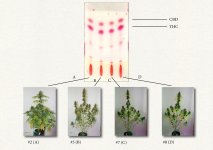
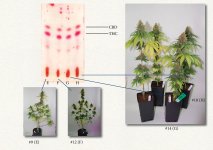
I had these checked over by Seb at Alpha-Cat who make the test kits and he said the plates came out well - so, posted below are the results.
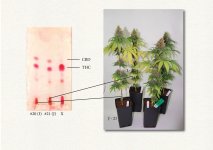
I'll follow up with a bit more explanation of this in the next day or two - all plants showed very nicely balanced ratios of CBD/THC, none of the profiles were extreme ie. high THC, no CBD. Just to confirm this, I also added an anonymous kush sample at the end (labelled 'X') for contrast.
Attachments
Last edited:

hello
Banned
podencoid you legend !!!
very cool to look at!
eyes have been playing pingpong between the two, - is it just the more pronounced the size and colour of the spot - the higher the reading ?, or is there more things to take into account ?
also, do you think it's just the genetics that make the thc more pronounced then the cbd on the tests ? (as would correlate with you thinking that these had more thc then the cannatonic (?) (sorry if that's wrong - from [appalling] memory)), or do you think environmental factors can tip the scales (i don't know if LED's have high UV output (?) ...or if that even makes a difference, or if something else might etc (??)).
did you do test the cannatonic too and do they have more pronounced CBD spots in comparison etc ?
VERY nice pictures, presentation etc and thankyou !!!
Last edited:
podencoid
New member
Hey Hello!
You got it - the bigger the spot the higher the percentage or presence of that cannabinoid.
I'll get back with a few more details tomorrow - putting the pics together, and a write-up I have been working on, took ages and I need to do other things for the rest of the day
The final test plate is interesting because you can see a high-strength THC plant (last one marked 'x') compared with these seeds.
Atb
Betterhaff
New member
That’s a great way to report the test kit findings, thanks podencoid. From what I can see from the plates it looks like #8 has the higher marks (I probably ran up the view counts because I looked at each of them numerous times). It will be interesting to see how the home test compares to what samples you send to the lab.
I looked at the Alpha Cat but it costs a fortune for international shipping and don’t think they have a distributor here. I like the fact that it’s a dip as opposed to a spray type. Looking forward to your additional report, the whole thread is top notch.
I looked at the Alpha Cat but it costs a fortune for international shipping and don’t think they have a distributor here. I like the fact that it’s a dip as opposed to a spray type. Looking forward to your additional report, the whole thread is top notch.
podencoid
New member
Thanks for your comments, Bettahaff.
Interesting, isn't it? I'm not using the kit to it's full potential, you can do more in-depth profiling of each plant but it uses up a lot of plates and can become costly. This other way of using the kit which I have done here, and which the maker recommends, is just to get a rough idea of which plants to develop or keep and my first impression is that it's pretty ideal for that.
I agree, #8 looks promising. There are 4 plants that stand out for me -
(Sorry about the arcane numbering system - I grew 21 seeds and numbered them 1 - 21 but after you took out the males it left odd numbers , then I had to add letters to simplify things a bit lol).
#14 (G) is my favourite plant for structure - it's mission is to stack buds I have a couple of little clones of it growing now because I didn't want to chuck them out and they clearly have great potential to be productive. Unfortunately, it appears to be THC dominant but I am tempted to cross it with some Otto#1/Harlequin seeds that I have to see what happens.
I have had a quick look around and watched some videos from other companies which make testing kits and they all seem to work on this same principle - Thin Layer Chromatography. There are a couple of kits made in the US which would be cheaper for you I think and probably just as good. I think spraying the dye would be ok from what I've seen.
I am going to have to take a break for a day or two but I'll be back next week with some more info and reports etc.
Atb
Interesting, isn't it? I'm not using the kit to it's full potential, you can do more in-depth profiling of each plant but it uses up a lot of plates and can become costly. This other way of using the kit which I have done here, and which the maker recommends, is just to get a rough idea of which plants to develop or keep and my first impression is that it's pretty ideal for that.
I agree, #8 looks promising. There are 4 plants that stand out for me -
#5 (B)
#8 (D)
#9 (E)
#18 (H)
#8 (D)
#9 (E)
#18 (H)
(Sorry about the arcane numbering system - I grew 21 seeds and numbered them 1 - 21 but after you took out the males it left odd numbers , then I had to add letters to simplify things a bit lol).
#14 (G) is my favourite plant for structure - it's mission is to stack buds
I have a couple of little clones of it growing now because I didn't want to chuck them out and they clearly have great potential to be productive. Unfortunately, it appears to be THC dominant but I am tempted to cross it with some Otto#1/Harlequin seeds that I have to see what happens. I have had a quick look around and watched some videos from other companies which make testing kits and they all seem to work on this same principle - Thin Layer Chromatography. There are a couple of kits made in the US which would be cheaper for you I think and probably just as good. I think spraying the dye would be ok from what I've seen.
I am going to have to take a break for a day or two but I'll be back next week with some more info and reports etc.
Atb

PlantManBee
Well-known member
wow, those look great and so do the LEDs. Impressive!
podencoid
New member
Thanks, PlantManBee.
I am trying out a Gavita Pro 600 at the moment, have to say I can't see huge difference between that and the results I was getting with LEDs so maybe I'll do an all LED run again next grow. The Gavita keeps the temps up at this time of year, though.
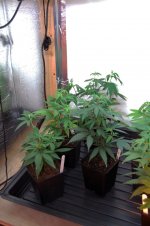
Little shot of the potential bonsai mums of the 4 CBD1 females that I plan to get lab tested.
A quote for you, PlantManBee:
Animals are something invented by plants to move seeds around. An extremely yang solution to a peculiar problem which they faced. - Terence McKenna
Attachments
podencoid
New member
Cannabinoid Analysis Kits
Wall of text warning... I'll break this up into a few posts for easier digestibility if anyone is interested:-
=========================================================
What is Thin Layer Chromatography? A simple explanation
The test kit I bought was from Alpha-Cat based in France - there are others available, but this happened to be the most convenient to buy where I live in Europe; the owner and developer of this kit, Sébastien, was helpful and patient when I fired questions at him, which is a good incentive to buy from him.
I’m not scientifically inclined, but from what I understand, the majority of test kits are based on the principle of Thin Layer Chromatography (TLC). The first few paragraphs of this Wikipedia article give a clear explanation of how it works Thin layer chromatography - Wikipedia, the free encyclopedia
Here’s an even more basic summary showing how TLC works in the context we are interested in.
We start with a TLC plate, which is a sheet of glass coated with a thin, uniform layer of silica gel or alumina. To carry out the process a small amount of solvent and sample substance is placed near the bottom of the TLC plate. The plate is then placed in a shallow pool with solvent in a developing chamber so only the very bottom of the plate is in contact with the liquid. This liquid, or carrier fluid, is the mobile phase which slowly rises up on the TLC plate (the stationary phase) by capillary action.
As the solvent moves through the little spot of cannabinoid-oil, (micro-droplet of I or 2 μL) which is applied on the bottom of the plate, the discrete components (cannabinoids) which differ in solubility and in strength are carried further up to the plate by the solvent.
When the solvent has reached the top of the plate, the plate is removed from the developing chamber and dried for 3 minutes. After drying, the now separated components (cannabinoids) in the silica layer are made visible by dipping the plate in a dye. This dye in these kits is produced specifically for cannabinoids. Every principal cannabinoid will display its own colour, for examples: THC=wine red, CBG=bright yellow, CBD=orange, CBN=violet and the size and intensity of the coloured spot can be measured to give an indication of the percentage of that cannabinoid in the sample. The bigger the spot is, the higher the concentration of that cannabinoid.
podencoid
New member
Using the Kit - The Testing Process
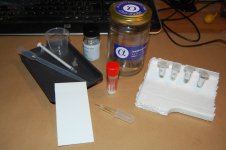
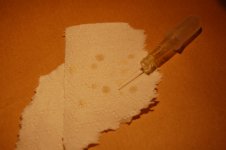
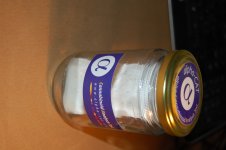
Firstly, I thought this was a well put together package. On the face of it, these kits seem dauntingly expensive but a ‘medium’ sized test kit from this supplier used for straightforward potency testing comes in at around 7.50 Euros per sample (£6.50) which sounds more reasonable. Everything is nicely presented and labelled and all the items to carry out the testing are included apart from a few items that the tester has to supply him/herself:
- Scales – these need to be able to weight to 0.01 of a gram so you might need to invest in new ones
- Water
- An oven
- Paper towels
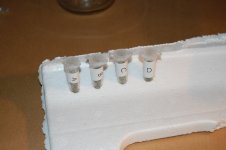
- Something to stand the sample vials in
- A flat-bed scanner for scanning the test plates in order to preserve the results
The glass capillary tubes, TLC plates, solvents and dyes are all standard Thin Layer Chromatography staples and probably fairly expensive in themselves but the added value of these kits is that they have been carefully scaled down to be appropriate for the home user. If I know anything at all about chemistry it’s that in order to be accurate all quantities and volumes must be carefully calibrated to one another and adhered to otherwise the process doesn’t work. Also, the charts used to measure the percentage profiles must have involved a considerable amount of research and preparation.
Back to the process.
First advice: read the protocol booklet and watch the video – many times if necessary.
Once you have overcome the bafflement, lay the contents of the kit out on a clean work surface and put on the nitrile gloves.
There are roughly 12 steps to carrying out this procedure – from weighing the sample and adding the carrier solvent to revealing cannabinoid profile spots on the TLC plate. I won’t go into detail on this, you would get a much better idea about it from watching the video or reading the booklet.
I didn’t run into any major problems but I would offer these words of advice (next post).
Attachments
podencoid
New member
Hints and warnings
- Experiment as many times as necessary getting the 1 or 2 μL test sample liquid into the measuring tube so that you can spot it on the test plate. I initially found this very tricky but kept practising with water coloured with food dye until I felt confident. This took many goes; we are talking microlitres here and the whole process hinges on keeping to these small-scale measurements.
- As above, read the protocol booklet and watch the video – many times if necessary.
- At the stage where you put the TLC plate in the oven for 40 seconds (to decarboxilate the sample so that you are getting a THC or CBD result, not a CBDa [acid] or THCa [acid] result). According to Sébastien, you can do this at 150 degrees C rather than the 100C stated in the booklet
- The solvent carrier and test plate developing solution is very volatile and liable to evaporate when left uncovered so make sure you keep all lids on jars and vials as soon as you have taken what you need from them. Also, work in a well-ventilated area – the solvent is quite ‘heady’.
- Work quickly and confidently – don’t leave some samples hanging around in their vials with solvent for too long because this may affect the results – CBD dissolves at a slightly slower rate than THC and you may end up with inaccurate results if you leave some samples soaking in solvent longer than others.
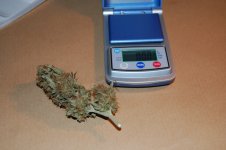
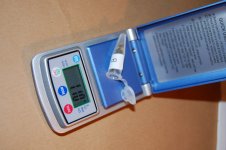
- Rather than trying to accurately weigh 1/10th of a gram of test material (cannabis flower) directly on the scales I found it easiest to weigh the Ependorff vial and then add the sample until I had reached the required weight – it seemed to be more accurate this way with the scales I was using.
podencoid
New member
The results
The results
You can do ‘chemotype profiling’ with this kit but I did a simple ‘potency test’ on these plants to establish the THC/CBD ratios. Here’s a sample plate below which shows percentages on these 4 plants of roughly 6-7% THC and 5-6%CBD. From these results I selected 4 plants from my original 10 for further lab testing which would give more detailed and accurate results.
Further uses
As well as bud samples, you can test hash, edibles, oils and any number of variations as detailed on their website. Also, more detailed chemotype profiling rather than the simpler potency profiling which I carried out.
Summary
The makers are not suggesting 100% accuracy but I found the process of working with this kit empowering and interesting. To be able to get an approximate guide to the plants you are working with and ingesting (especially for CBD rich strains) without costly lab testing is a game-changer for me and I plan to be a regular user of this kit in the future.
Further reading
Cannabis Analysis Test AlphaCAT® | The New Cannabinoid Analytical Tool!
Comparative study for the quantification of THC, CBD and CBN.. | Fundacion Canna laboratorio de pruebas de cannabis
Video: Alpha-CAT | Protocolo paso a paso para analizar los Cannabinoides - YouTube
podencoid
New member
Hi AhsocDT
You're welcome - Shanti's strains are the most reliable for near 1:1 content but there are some Harlequin X's around which lean more to higher CBD.
I've just popped some Harlequin's and other X's and we'll see how they turn out. I'll try and post a diary if the grow looks promising but I struggled with the last one to get things dialed in properly so if I overcome my false pride and environment problems I'll get another diary up
May also a bit of pollen chucking with the CBD1 clones which have lovely genetics and some Harlequin's to see (for my own use) whether I can get a very CBD leaning pheno. I love Cannatonic but as discussed on another thread no regs available at the moment - Resin Seeds had a police raid on their greenhouses and it set them back a bit from what they tell me.
Atb
Hi AhsocDT
You're welcome - Shanti's strains are the most reliable for near 1:1 content but there are some Harlequin X's around which lean more to higher CBD.
I've just popped some Harlequin's and other X's and we'll see how they turn out. I'll try and post a diary if the grow looks promising but I struggled with the last one to get things dialed in properly so if I overcome my false pride and environment problems I'll get another diary up
May also a bit of pollen chucking with the CBD1 clones which have lovely genetics and some Harlequin's to see (for my own use) whether I can get a very CBD leaning pheno. I love Cannatonic but as discussed on another thread no regs available at the moment - Resin Seeds had a police raid on their greenhouses and it set them back a bit from what they tell me.
Atb
Good luck with your journey!
Seedsman.com just responded to my inquiry about regular Cannatonic:
"I hope we will have Cannatonic very soon. You can sign up to be notified of when it is back in stock on the product page."
I'll wait for it!
Cheers, Ahsoc
podencoid
New member
Back with a little more on this test grow.
We got the lab test results back for 4 of the plants which seemed to show interesting results with the Alpha-Cat kit. Three of the plants tested a little low in THC/CBD, around 4% - 6% but one stood out a bit higher at 6.5 THC and 7.21 CBD.
Here's the mother plant I kept of that one and one of its cuttings that I am currently growing - Mum on the right, clone on the left:

I'll do another update soon of my current grow - I have some Harlequin x Otto #1 crosses. Just out of curiosity I have pollinated some of these CBD #1 plants with the Harlequin/Otto cross to see if I can push them in the direction of higher CBD .... it's just an experiment in pollen-chucking, I'm not trying to create a stable strain, it's just to see if it results in anything interesting that can be kept as a mum when I grow them out.
I've also made some seeds with the plant in the photo above and one of Bodhi's Harlequin X's. It had to be done
I'll do an update on my current grow asap...
Atb
We got the lab test results back for 4 of the plants which seemed to show interesting results with the Alpha-Cat kit. Three of the plants tested a little low in THC/CBD, around 4% - 6% but one stood out a bit higher at 6.5 THC and 7.21 CBD.
Here's the mother plant I kept of that one and one of its cuttings that I am currently growing - Mum on the right, clone on the left:
I'll do another update soon of my current grow - I have some Harlequin x Otto #1 crosses. Just out of curiosity I have pollinated some of these CBD #1 plants with the Harlequin/Otto cross to see if I can push them in the direction of higher CBD .... it's just an experiment in pollen-chucking, I'm not trying to create a stable strain, it's just to see if it results in anything interesting that can be kept as a mum when I grow them out.
I've also made some seeds with the plant in the photo above and one of Bodhi's Harlequin X's. It had to be done
I'll do an update on my current grow asap...
Atb

podencoid
New member
Hi Blackmesa
The Alpha-Cat test didn't really indicate 1:1 and wasn't that accurate in some ways but was very helpful in indicating a significant presence of CBD... the lab test showed an almost 1:1 ratio for this plant: 6.5 THC / 7.21 CBD.
Is that what you meant?
Out of the 10 females two plants stood out for me - one was this one in the photo with roughly 1:1 ratios and the other was a plant that just seemed to yield more than the others.
I kept mums of both of these and hope to make some seeds with the high-yielder and a Harlequin X just to see if it can be pushed towards being a 2:1 or more high CBD strain... it could come to nothing, who knows
They were all great plants to grow with some strong orangey smells and resin (from the Afghan Skunk side I guess) and nice structures. The Harlequin X's I'm growing now have a very lemon/citrus odour.
All the best with your grows - I'll have a look in when I can.
podencoid
New member
A little grow update of plants currently fnishing.
This one is a cutting from the 6.5 THC / 7.21 CBD mother from one of CBD1 test seed plants. It's a chunky little plant just in a 3.5 lt pot this time. I made a few seeds with it on lower branches with 2 males, an 'Otto#1 x Harlequin# F2 and a 'Harlequin x Appalacia' from Bodhi. I couldn't help myself
The CBD1 testers have been great to have around for making edibles the last few months.

Also, a CBD Mango Haze about 3.5 ft tall, topped to four branches. Beautiful plant which seems to be filling out nicely.
Atb

This one is a cutting from the 6.5 THC / 7.21 CBD mother from one of CBD1 test seed plants. It's a chunky little plant just in a 3.5 lt pot this time. I made a few seeds with it on lower branches with 2 males, an 'Otto#1 x Harlequin# F2 and a 'Harlequin x Appalacia' from Bodhi. I couldn't help myself
The CBD1 testers have been great to have around for making edibles the last few months.
Also, a CBD Mango Haze about 3.5 ft tall, topped to four branches. Beautiful plant which seems to be filling out nicely.
Atb